
Gateway partners with Tumar Innovation Hub to advance institutional digital finance in Kazakhstan
Bringing regulated onchain financial infrastructure to banks and financial institutions.
Astana / Stavanger, 21 October 2026. Gateway has signed a strategic memorandum of understanding with Tumar Innovation Hub (legal name: Al-Farabi Innovation Hub), an Astana International Financial Centre (AIFC) company. Together they will help banks, financial institutions and public-sector bodies in Kazakhstan, and in time across Central Asia, move from exploring digital assets to running them in production.
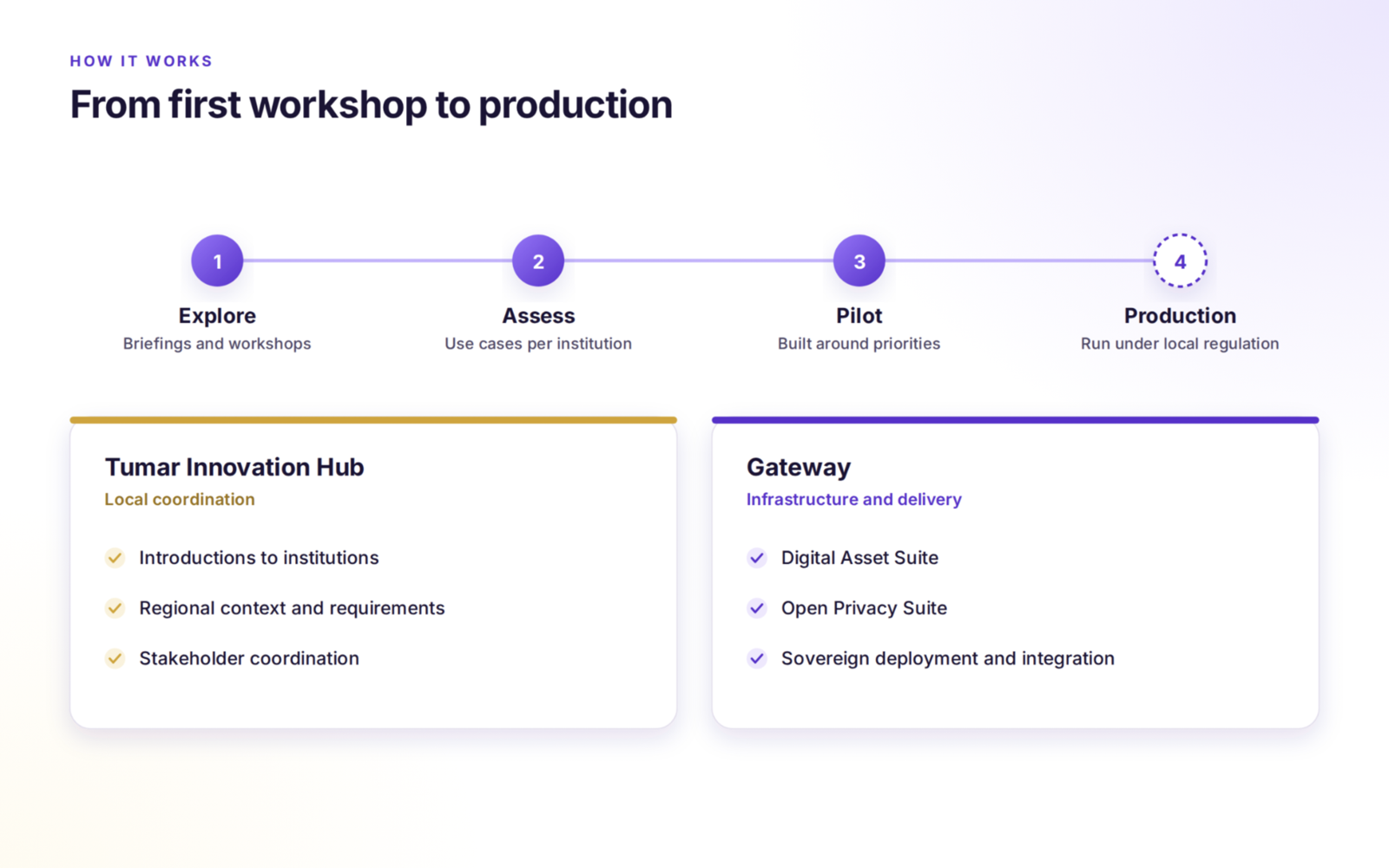
For local institutions, the partnership offers a practical route to regulated onchain finance. They gain access to Gateway’s infrastructure and integration team, while Tumar Innovation Hub coordinates locally and brings an understanding of institutional requirements in Kazakhstan. Workshops, use-case assessments and pilots will be built around each institution’s own priorities. The partners will address the questions banks are now asking: how a tokenized deposit or bond connects to core banking, who operates the network and where the data stays, and what a supervisor can see and how that access is recorded.
Kazakhstan’s digital asset law, in force since 1 May 2026, recognises money-backed stablecoins and tokenized real assets as digital financial assets. On 7 October, the National Bank of Kazakhstan, Tether and the Alatau City Authority signed an MoU to explore a tenge-pegged stablecoin and an asset tokenization pilot. Together, these developments are creating new opportunities to explore how regulated digital assets can support payments, financing and settlement within Kazakhstan’s financial system.
What the partnership covers
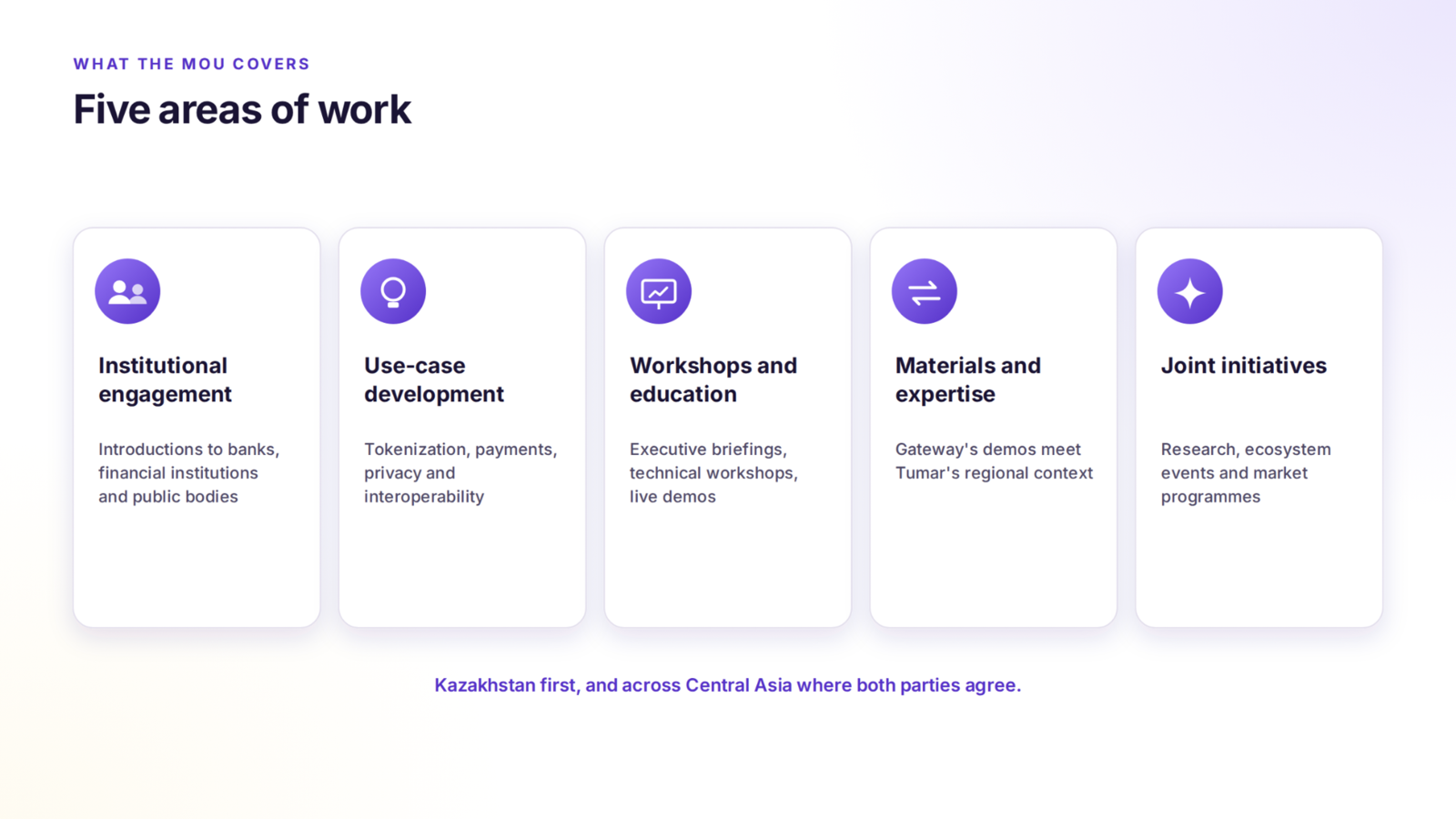
Under the MoU, Gateway and Tumar Innovation Hub will work together across five areas:
- Institutional engagement. Tumar will introduce Gateway to banks, financial institutions, public-sector bodies, industry organisations and technology partners in Kazakhstan, and in other Central Asian markets where both parties agree.
- Use-case development. Together the partners will explore digital asset infrastructure, tokenization, payments and settlement, privacy, identity and governance, and interoperability. They will assess opportunities with institutions and map pathways to pilots and implementation.
- Workshops and executive education. Executive briefings, technical workshops, roundtables and live demonstrations, designed around individual institutions or the wider market.
- Materials and expertise. Gateway will bring product demonstrations and technical and commercial expertise; Tumar Innovation Hub will bring regional context, stakeholder coordination and feedback on local institutional requirements.
- Joint initiatives. Research, ecosystem events and market-development programmes where the two organisations’ capabilities complement each other.
The partnership is already under way. On 9 October 2026, Al-Farabi Innovation Hub organised, in coordination with the National Bank of the Republic of Kazakhstan, a first joint online session introducing Gateway to the country’s second-tier banks, and follow-up discussions with interested institutions have begun.
What Gateway brings
Gateway is the institutional infrastructure orchestrator for sovereign onchain finance. For a Kazakh bank, that means:
- Tokenization, payments and settlement through Gateway’s Digital Asset Suite: tokenized deposits, bonds and securities, funds and private credit, cross-border payment corridors and delivery-versus-payment, built around the bank’s existing core systems.
- Privacy that supervisors can work with, through Open Privacy Suite: each participant sees only what policy allows, supervisors receive a scoped and logged view, and every access decision is recorded. It is open source under Apache 2.0.
- Sovereign deployment. Dedicated networks, data residency and deployment in the institution’s own cloud, on premises or in-region, so data and keys stay where the regulator expects them.
- Orchestration with specialist partners, so custody, identity, compliance and liquidity come from providers suited to the market, under one deployment and one operating model.
Gateway has run production blockchain infrastructure since 2021 and serves more than 20 billion requests a month.
Zhanna Tulevoka, CEO, Al-Farabi Innovation Hub:
“Kazakhstan’s banks already understand why digital assets matter; what they need now is infrastructure they can run under local regulation and a partner who can take them from pilot to production.”
Pradeep RV Singh, co-founder and CEO of Gateway:
“Kazakhstan has moved faster than most markets in putting a legal framework for digital assets in place, and its banks are now asking how to run these services in production. We want to help them do that with infrastructure they control, alongside a partner who knows the market and its institutions.”
What comes next
The partners will hold a series of executive and technical workshops with interested institutions over the coming months, starting with tokenized deposits, payments and settlement, and privacy for shared networks.
About Tumar Innovation Hub
Tumar Innovation Hub (legal name: Al-Farabi Innovation Hub) was launched in 2025 with the initiative of Astana Hub in Kazakhstan and IT Park in Uzbekistan under the management of White Hill Capital Group, a company with deep expertise in venture investment and international market entry. Tumar serves as a strategic bridge for IT companies and startups from Central Asia and other countries entering the dynamic and fast-growing UAE market.
About Gateway
Gateway is the institutional infrastructure orchestrator for sovereign onchain finance. We combine platform, specialist partners and an integration team to help banks, market infrastructures and financial institutions bring regulated financial products onchain, under their own rules, brand and jurisdiction. Founded in Norway in 2021, Gateway operates globally.
MarketsKazakhstan · Central Asia