
Gateway enters Islamic finance with sovereign, private, Sharia-ready infrastructure
One modular architecture for Islamic capital markets, enforced by your Sharia board's rules, and built for the AI agents that will increasingly act on your behalf.
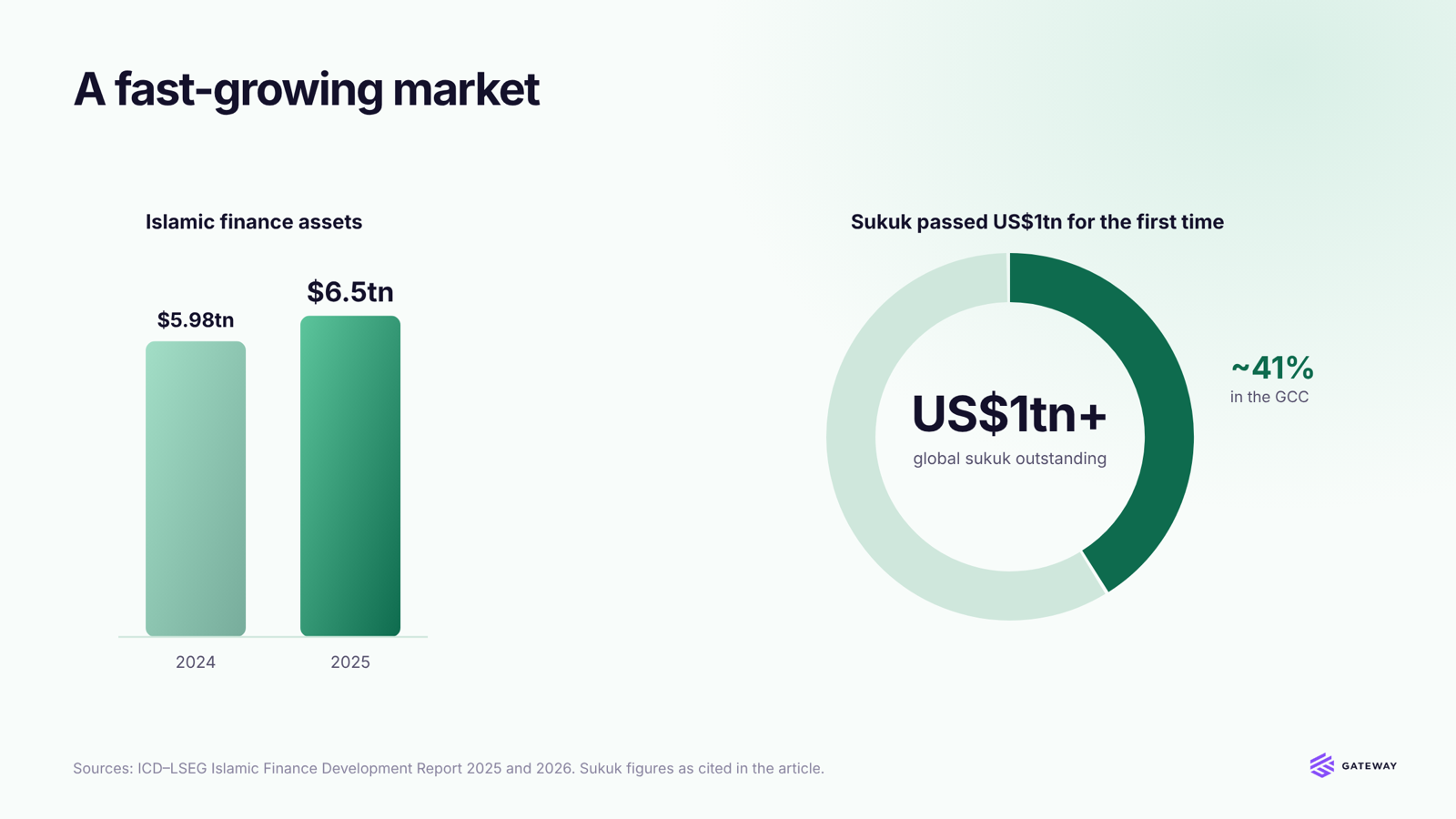
Islamic finance is one of the fastest-growing parts of global finance. Its assets reached US$6.5 trillion in 2025, according to the ICD–LSEG Islamic Finance Development Report 2026, and global sukuk outstanding passed US$1 trillion for the first time, with around 41% of it in the GCC.
Today, Gateway is entering Islamic finance with Gateway Islamic Finance: sovereign, private, Sharia-ready infrastructure for Islamic capital markets, with an agentic framework built in.
Since 2021, we have built and operated institutional blockchain infrastructure in production: sovereign networks, privacy and governed access, tokenization and settlement, for more than 40 institutional clients, including in the Middle East. Islamic finance asks for exactly what that infrastructure does best: one shared record of ownership, rules enforced every time, and a clear view for everyone entitled to see it, inside the institution's own jurisdiction.
The pilots have started. The harder part comes next.
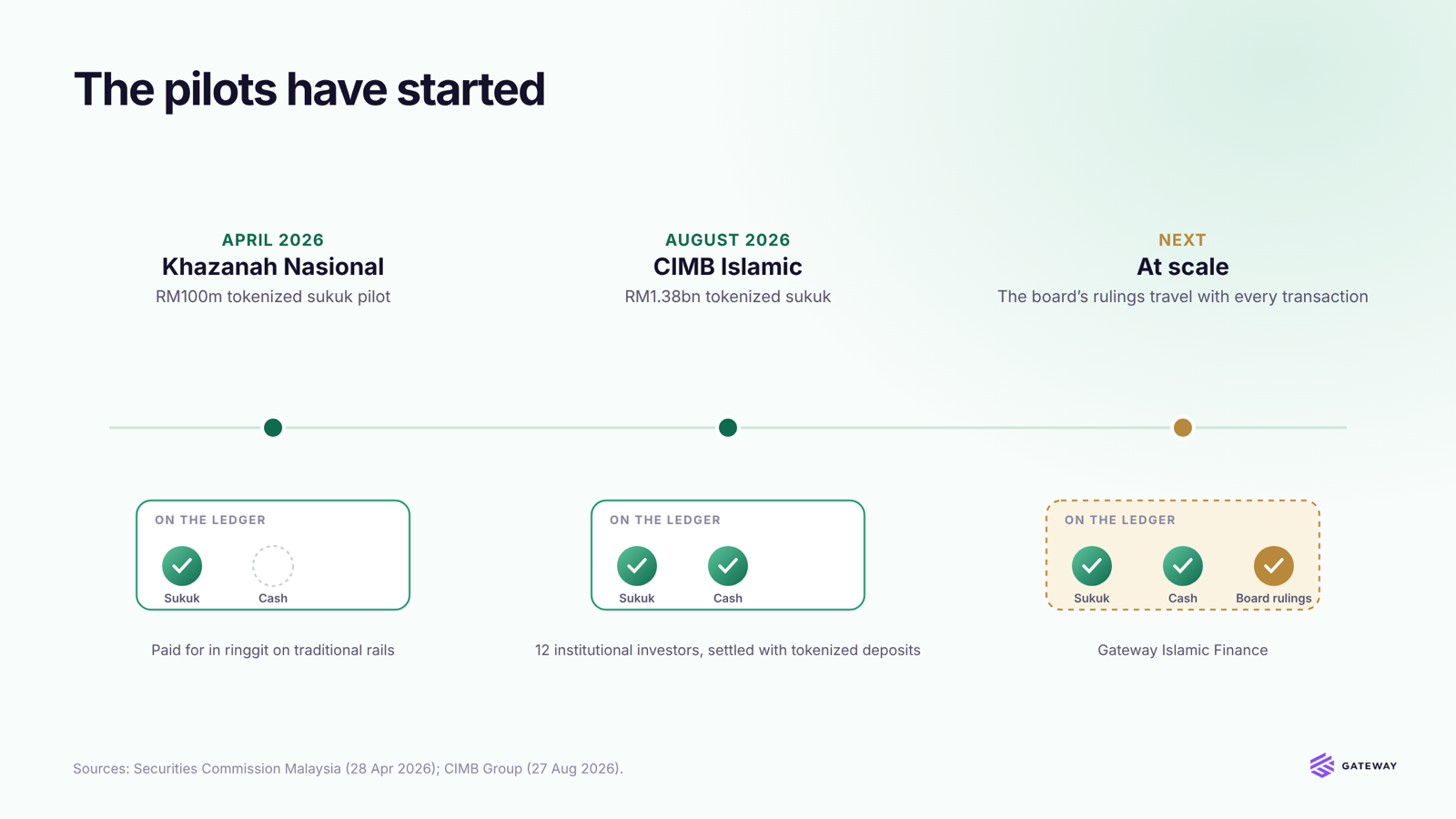
In April, Khazanah Nasional priced Malaysia's first tokenized sukuk: a RM100 million pilot with the Securities Commission, paid for in ringgit on traditional rails. In August, CIMB Islamic went further. It issued RM1.38 billion of tokenized sukuk, subscribed by 12 institutional investors and settled with tokenized deposits, so both the security and the money moved on the same ledger.
Those pilots settled one question: Islamic instruments can live on a ledger. The harder question is whether the infrastructure can carry the Sharia board's rulings with them, on every transaction, at scale. That is the question Gateway Islamic Finance is built to answer.
Islamic finance was designed for shared risk. Its infrastructure wasn't.
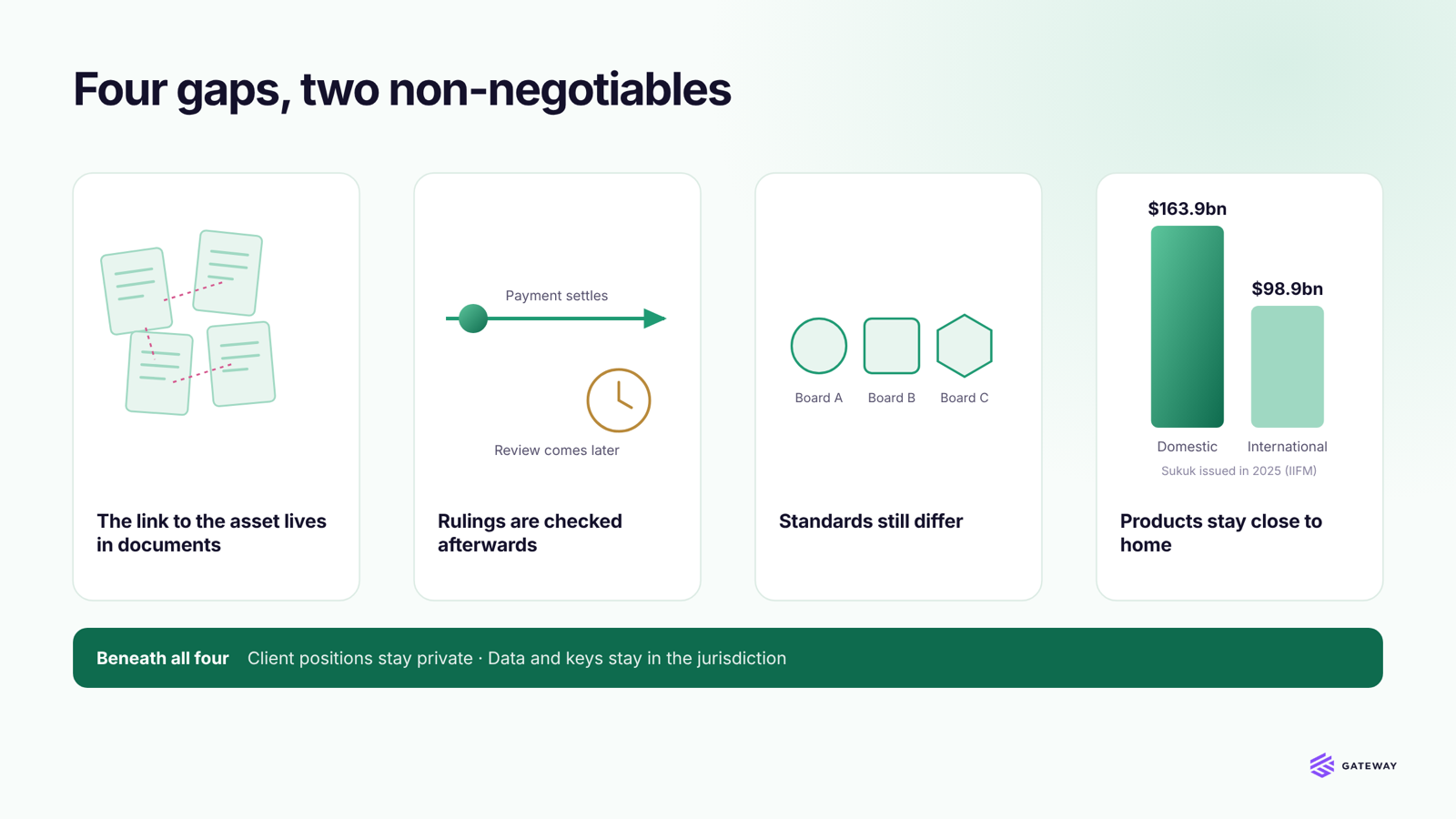
The principles are clear: finance tied to real assets, profit and loss shared on agreed terms, clear contracts and no interest. The infrastructure underneath was mostly built for conventional finance, and four gaps follow.
The link to the asset lives in documents. A sukuk's certificate, its underlying asset, the rent it earns and its register of investors often sit with different parties, in different systems, reconciled after the fact.
Rulings are checked afterwards. The board approves a structure, and compliance in operation is confirmed later, through review and audit. Nothing in a typical payment system stops a transfer that would break a ruling.
Standards still differ. When AAOIFI proposed changes to its Shariah Standard 62 in 2025, critics warned that uneven implementation across jurisdictions could create legal uncertainty. Infrastructure that hard-codes one interpretation cannot serve a market that applies several.
Products stay close to home. Most sukuk are still issued domestically. In 2025, domestic issuance reached US$163.9 billion, against US$98.9 billion internationally, according to the IIFM.
And beneath all four sit two non-negotiables. An institution cannot put client positions on a ledger everyone can read, or let its data and keys leave its jurisdiction.
One modular architecture for your Islamic capital market
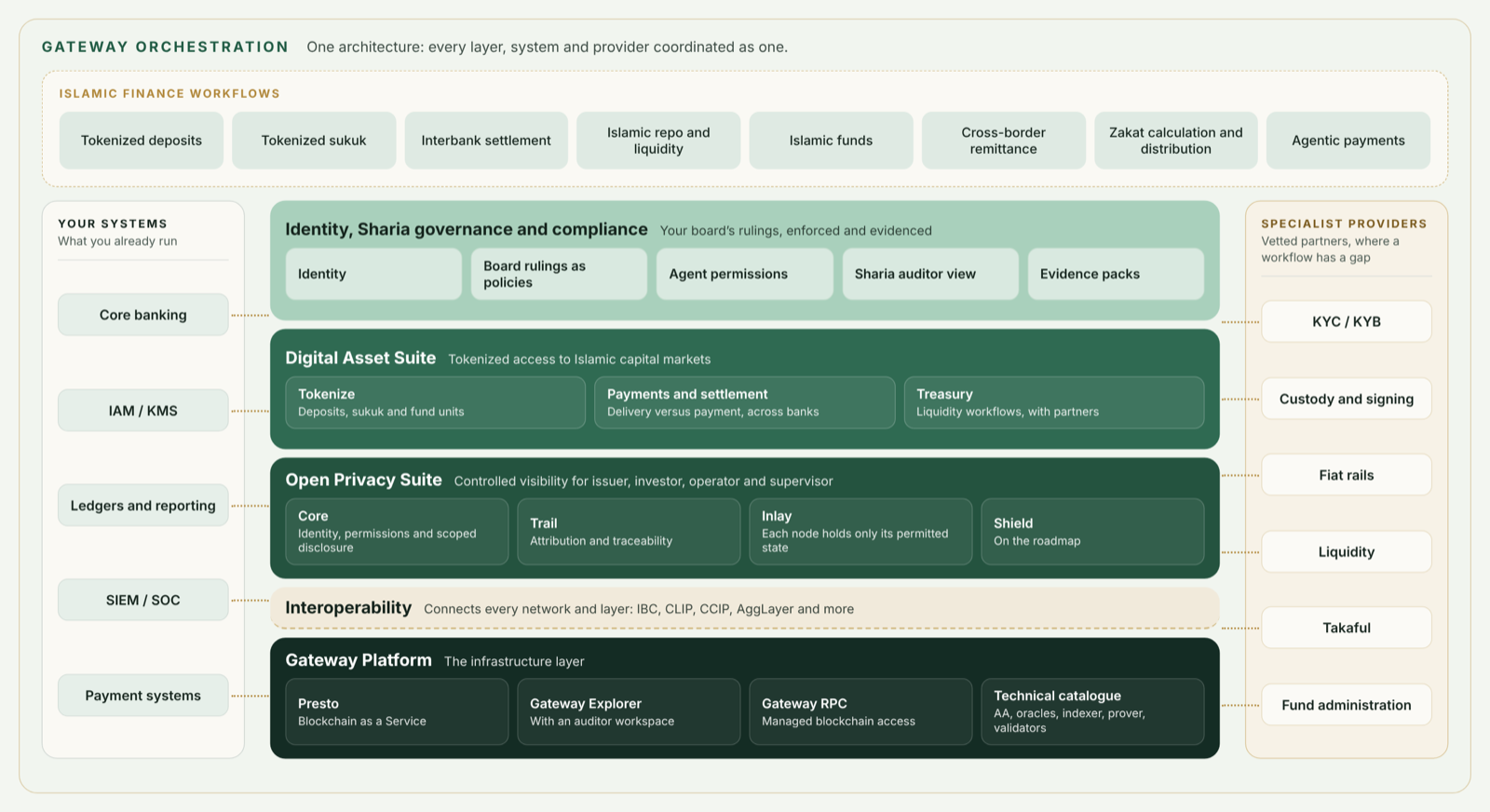
Gateway Islamic Finance uses the same orchestrated architecture we run for institutions today, with a Sharia governance layer at its center. Modular layers, your systems and specialist providers are coordinated as one through Gateway Orchestration, and your board approves what runs on top.
- Islamic finance workflows: tokenized deposits and sukuk, interbank settlement, Islamic repo and liquidity, Islamic funds, cross-border remittance, zakat calculation and distribution, and agentic payments.
- Identity, Sharia governance and compliance: board rulings as policies, agent permissions, a Sharia auditor view and evidence packs.
- Digital Asset Suite: tokenization of deposits, sukuk and fund units, delivery-versus-payment settlement across banks, and treasury workflows with partners.
- Open Privacy Suite: controlled visibility for issuer, investor, operator and supervisor, through Core, Trail and Inlay, with Shield on the roadmap.
- Interoperability: connections across networks through IBC, CLIP, CCIP, AggLayer and more.
- Gateway Platform: Presto blockchain as a service, Gateway Explorer with an auditor workspace, Gateway RPC and the technical catalogue.
- Specialist providers: vetted partners for KYC and KYB, custody and signing, fiat rails, liquidity, takaful and fund administration.
- Your systems: core banking, identity and key management, ledgers and reporting, security operations and payment systems.
Because every asset class shares the same rails, a bank that starts with tokenized deposits can add sukuk or funds later as modules, not as new systems.
Enforced by your board's rules
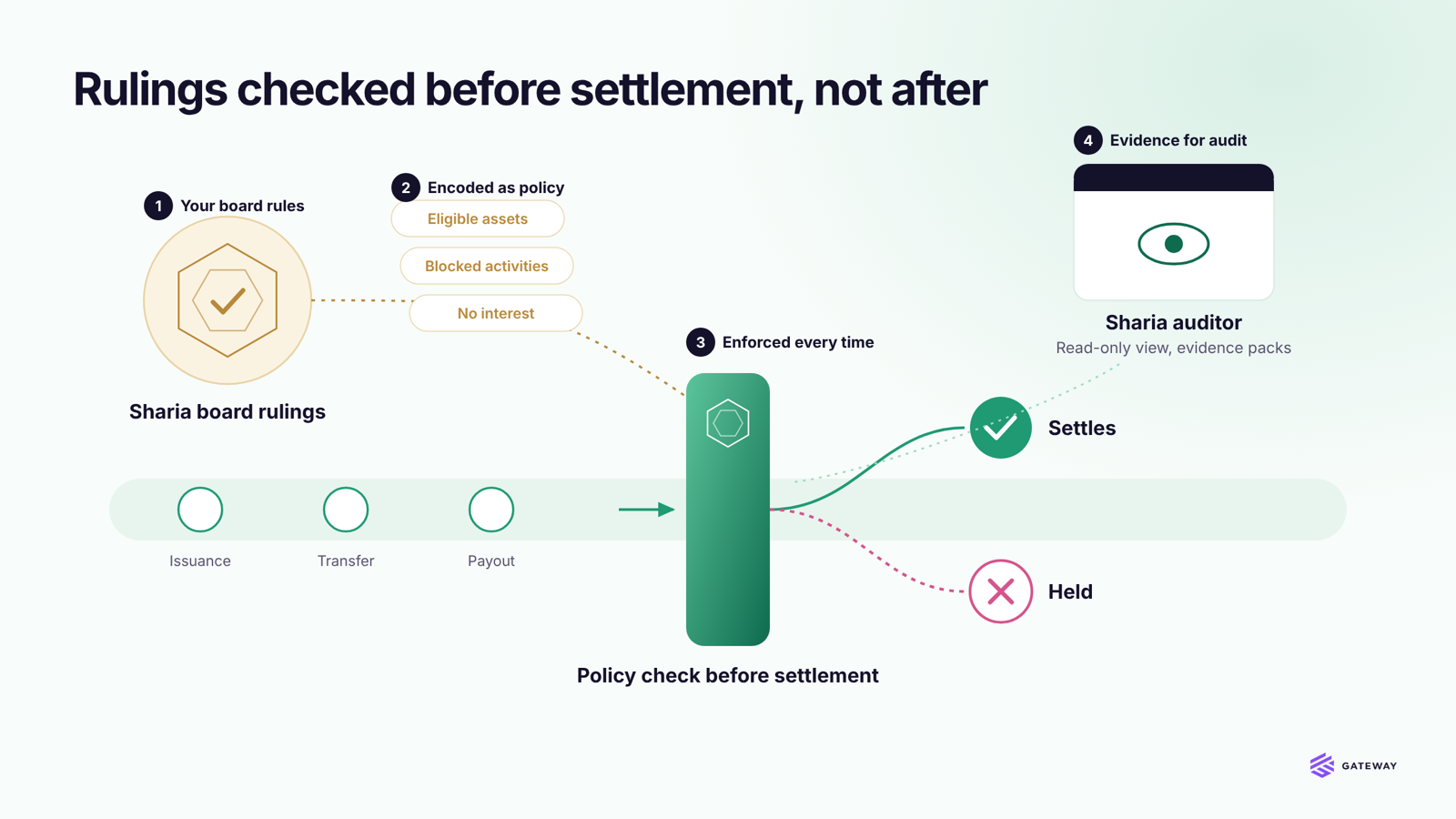
What makes the architecture Sharia-ready is that your board's rulings are built into it, and checked before anything settles:
- Your board rules. Your Sharia Supervisory Board approves the structure and its conditions.
- Encoded as policy. Rulings become policies, such as eligible assets, blocked activities and no interest accrual.
- Enforced every time. Each issuance, transfer and payout is checked before it settles.
- Evidence for audit. A permissioned, read-only view gives your Sharia auditor what they need, and nothing more.
For an Ijara sukuk, that means confirming each certificate is tied to the leased asset, and that holders receive rent, not interest, split pro-rata, before payment is made. Because the policies come from your board, the platform carries your board's interpretation, not ours. The workflows support Ijara, Wakalah and Murabaha structures, and Qard or Wadiah for current accounts. Your board decides which structure fits each product.
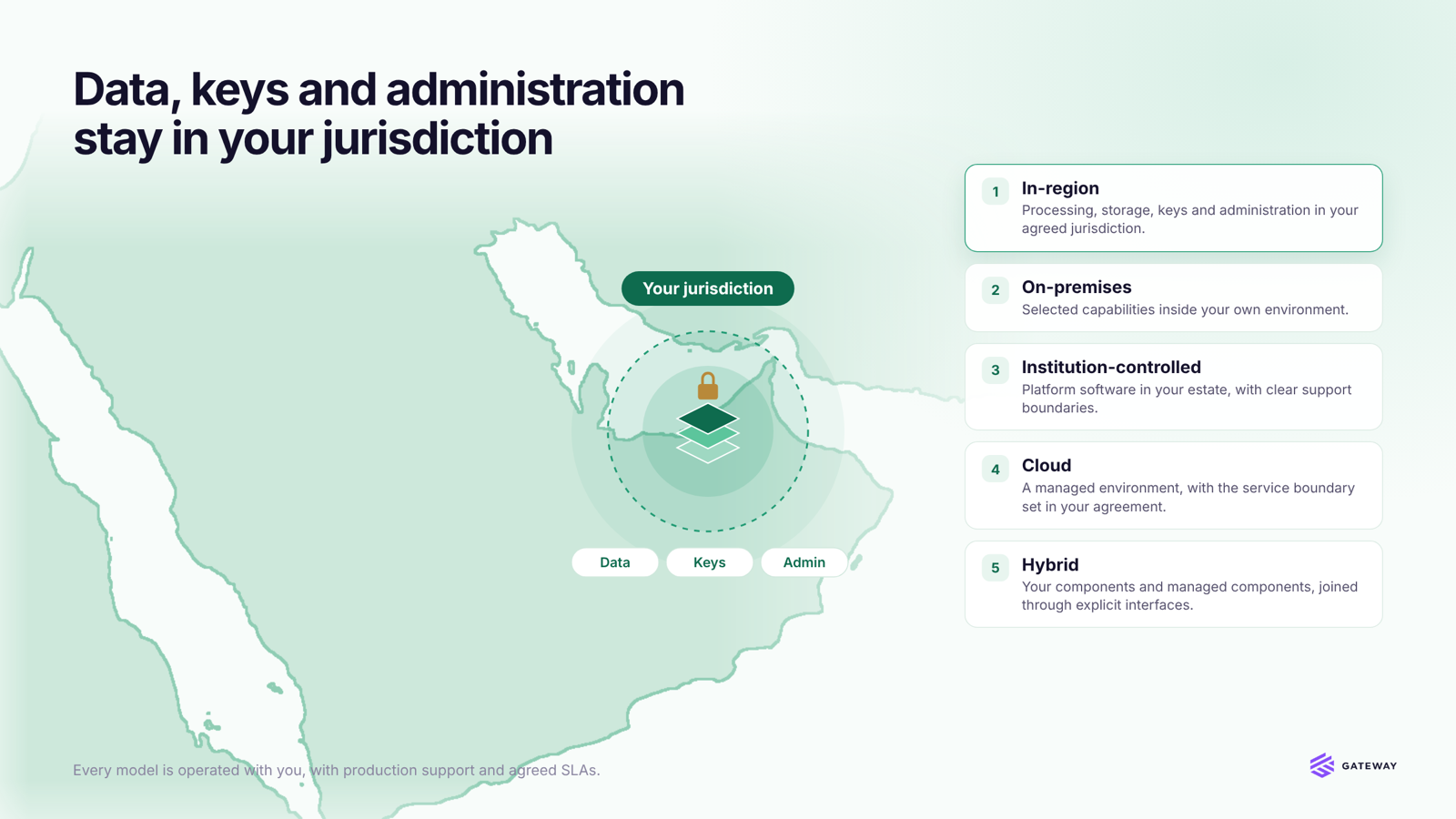
The architecture also runs where your board and regulator need it: in-region, on-premises, institution-controlled, in the cloud or as a hybrid, with data, keys and administration kept in your jurisdiction. Through Open Privacy Suite, each party sees only what it is permitted to see.
AI agents, inside your board's rules
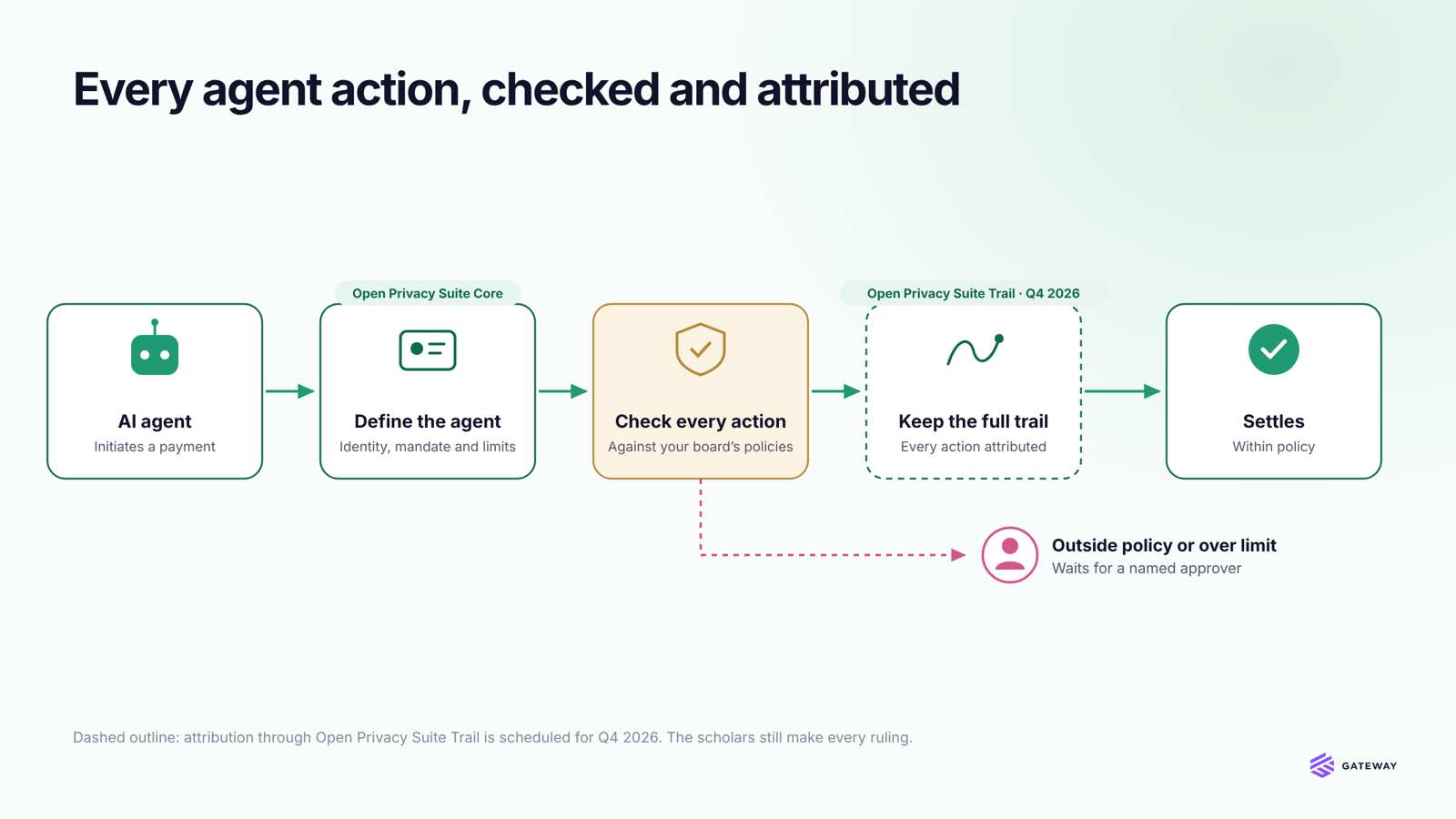
AI agents are starting to initiate payments and run routine financial tasks for institutions. In Islamic finance, an agent is one more actor that must follow the board's rulings, with no exceptions. Gateway's agentic framework, built on Open Privacy Suite Core and Trail, makes that enforceable:
- Define the agent. Each agent has its own identity, mandate and limits: what it can do, what it cannot, and where its boundaries are.
- Check every action. Each payment is checked against your board's Sharia policies before it settles. Anything outside policy, or over the agent's limit, waits for a named approver.
- Keep the full trail. Every action is attributed and recorded, so your Sharia auditors can see what each agent did and why it was allowed. Full attribution comes with Open Privacy Suite Trail, scheduled for Q4 2026.
Agents can also support the board, by screening activity and preparing evidence. Your scholars still make every ruling.
See it working
Two working demonstrations are live on our website, run with synthetic funds:
- A Sharia-ready tokenized deposit: funds stay in core banking while a deposit token moves at par between holders, with no yield.
- A tokenized Ijara sukuk: certificates represent a leased asset, and rent, not interest, is paid to holders in a dirham stablecoin.
Any product built on them needs qualified Sharia review. See the demos
Clear roles, from workshop to production
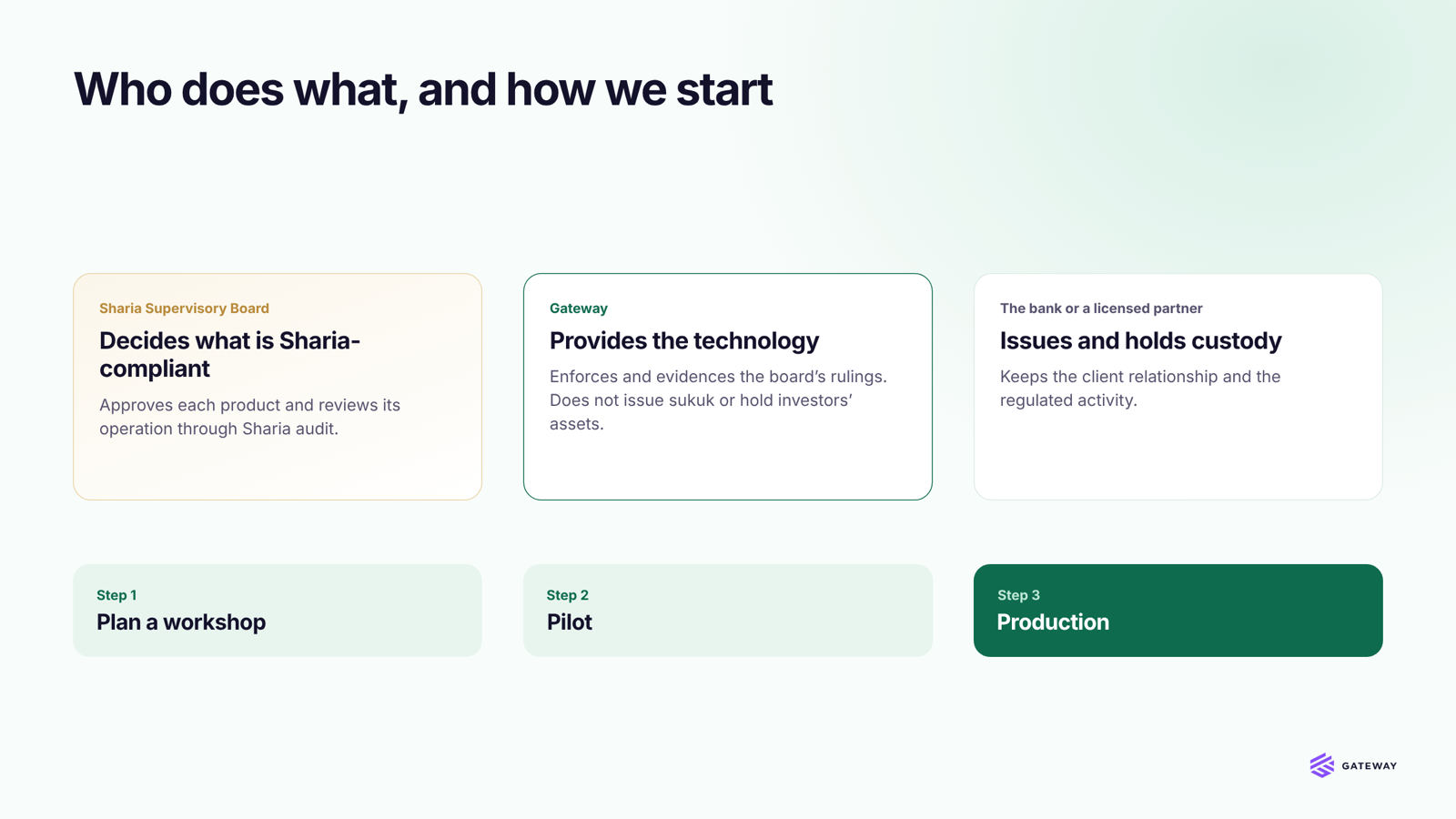
Gateway provides the technology. Your Sharia Supervisory Board decides what is Sharia-compliant, and Gateway enforces and evidences its rulings. Gateway does not issue sukuk or hold investors' assets: your bank, or a licensed partner, issues, holds custody and keeps the client relationship.
We start with a Sharia-ready workshop with our team in the UAE, mapping your structure, your actors and your board's requirements. Then comes a pilot with the evidence your board needs, and then production in your chosen deployment.
Book a Sharia-ready workshop · gateway.fm/islamic-finance
Gateway provides technology. The Sharia compliance of any product is determined by the client's Sharia Supervisory Board.
Sources
- Khazanah tokenized sukuk: The Edge Malaysia and The Star, 28–29 Apr 2026
- CIMB tokenized sukuk settled with tokenized deposits: The Edge Malaysia and Ledger Insights, 27 Aug 2026
- Islamic finance assets: ICD–LSEG Islamic Finance Development Report 2026
- Sukuk outstanding and domestic vs international issuance: IIFM Sukuk Report 2026 (15 Sep 2026)
- GCC share of sukuk outstanding: Fitch, Global Sukuk Market Monitor 2026
- AAOIFI Shariah Standard 62 debate: industry coverage, 2025
- Gateway product claims: gateway.fm/islamic-finance
MarketsGCC · Middle East · Southeast Asia