GATEWAY
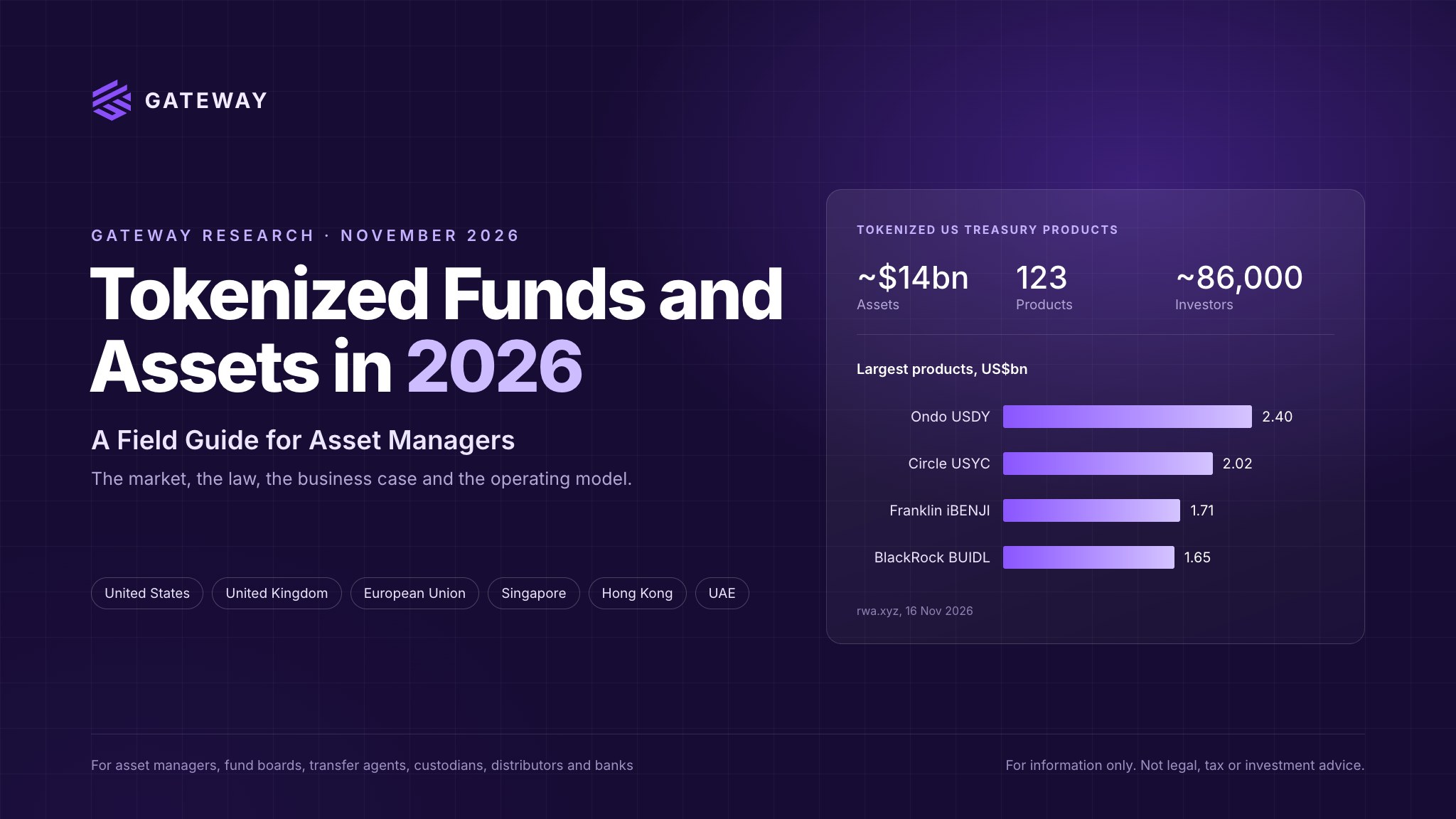
Gateway Research flagship report: Tokenized Funds and Assets in 2026, a field guide for asset managers. About $14bn in tokenized US Treasury and money market products across 123 products, November 2026.

Tokenized Funds and Assets in 2026: A Field Guide for Asset Managers

The market, the law, the business case and the operating model

By Gateway Research27 min read

Flagship report · November 2026

How do you want to read this report?

Tokenized US Treasury and money market products
~$14bn
Products tracked, 16 Nov 2026
123
Jurisdictions compared
6
Figures and exhibits
11
The report in eight findings

Key findings

  1. 01Tokenization is a change to the register, not to the asset.
    A tokenized fund share is still a fund share, subject to the same securities, fund and investor-protection law. What changes is how ownership is recorded and transferred. Regulators in the US, UK, EU, Singapore and Hong Kong have now said so explicitly.
    The evidence, §1 →
  2. 02The market is real but small.
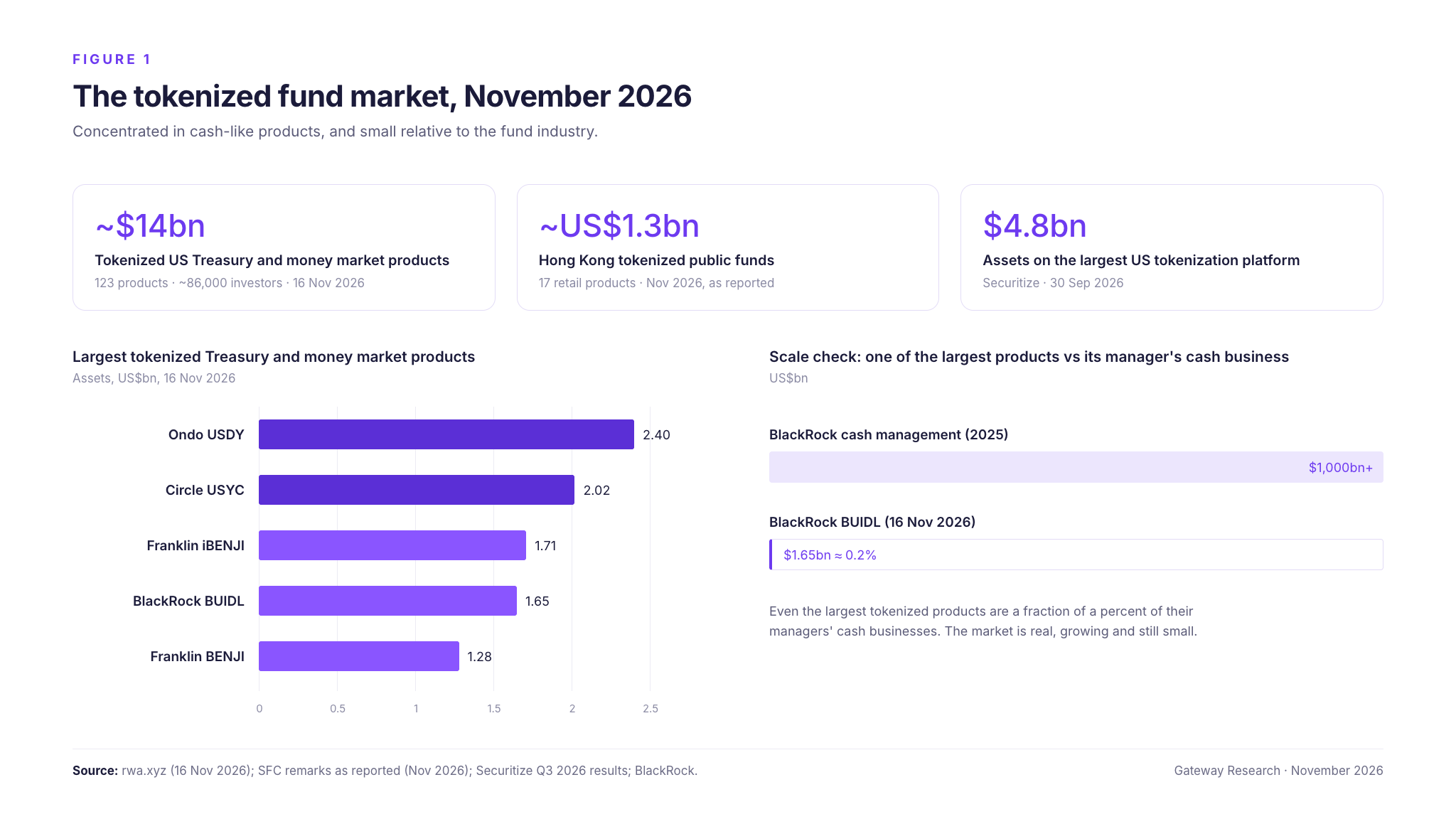
    Tokenized US Treasury and money market funds held about $14 billion in November 2026, and Hong Kong's tokenized public funds about US$1.3 billion. Both are tiny against a global fund industry measured in tens of trillions.
    The evidence, §2 →
  3. 032026 was the year the legal path cleared.
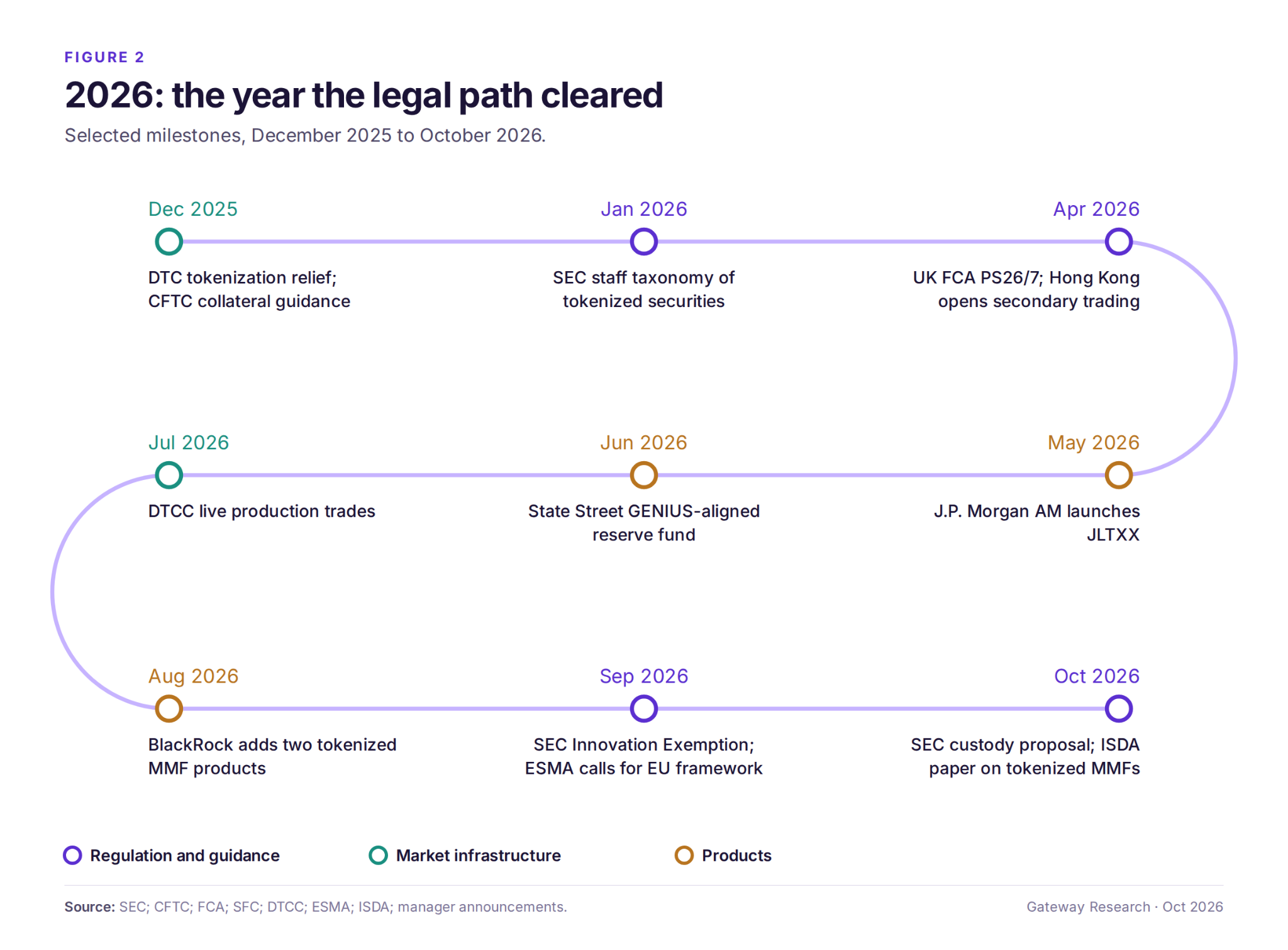
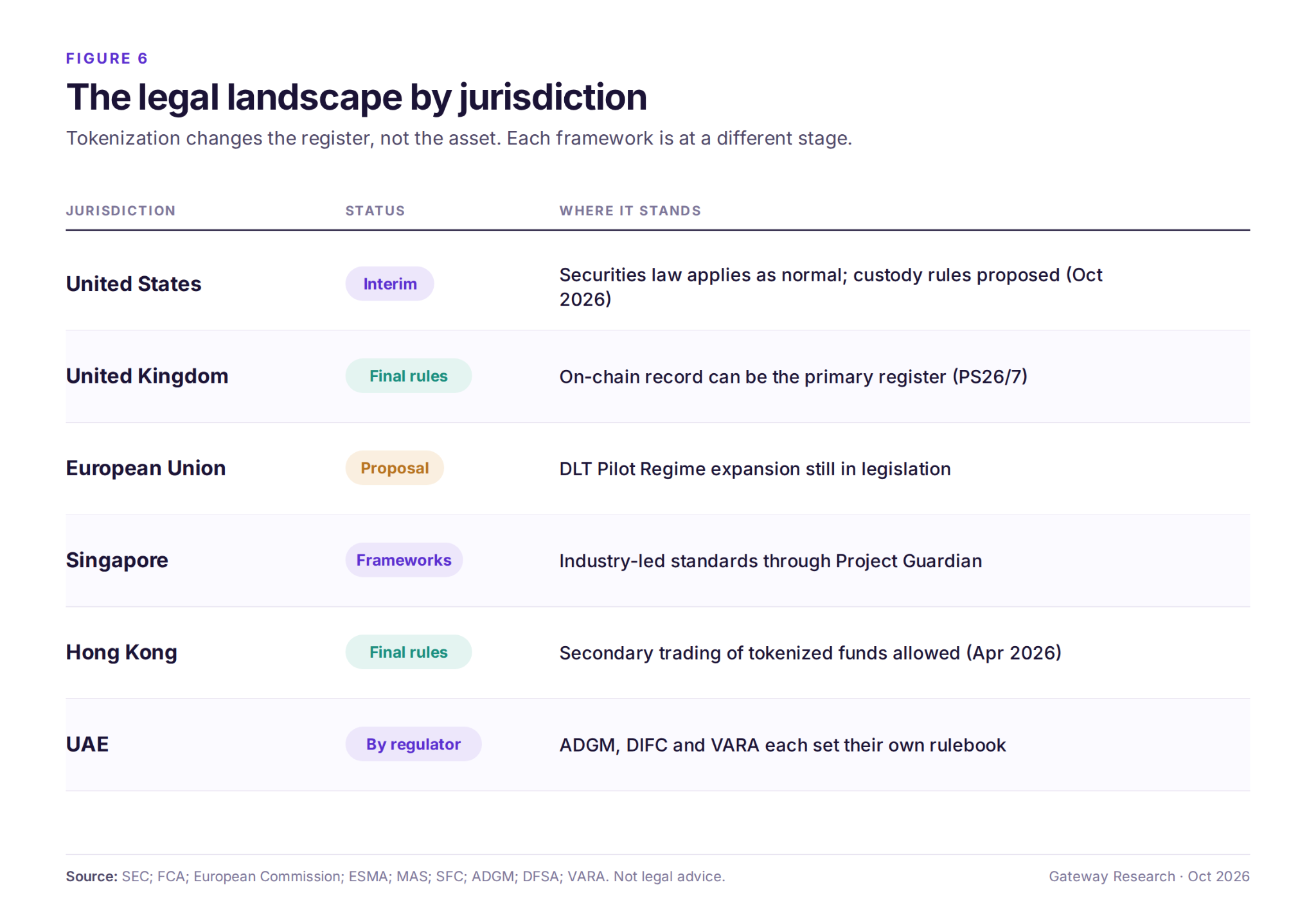
    The SEC staff set out a taxonomy of tokenized securities (January). The FCA finalized rules allowing an on-chain register to be a fund's primary record (April). Hong Kong opened secondary trading of tokenized funds (April). The EU proposed making its DLT Pilot Regime permanent and far larger. And the US issued tokenized-collateral guidance, a custody proposal and a framework under which stablecoin reserves can include money market funds, including in tokenized form.
    The evidence, §6 →
  4. 04How a fund is tokenized matters as much as whether.
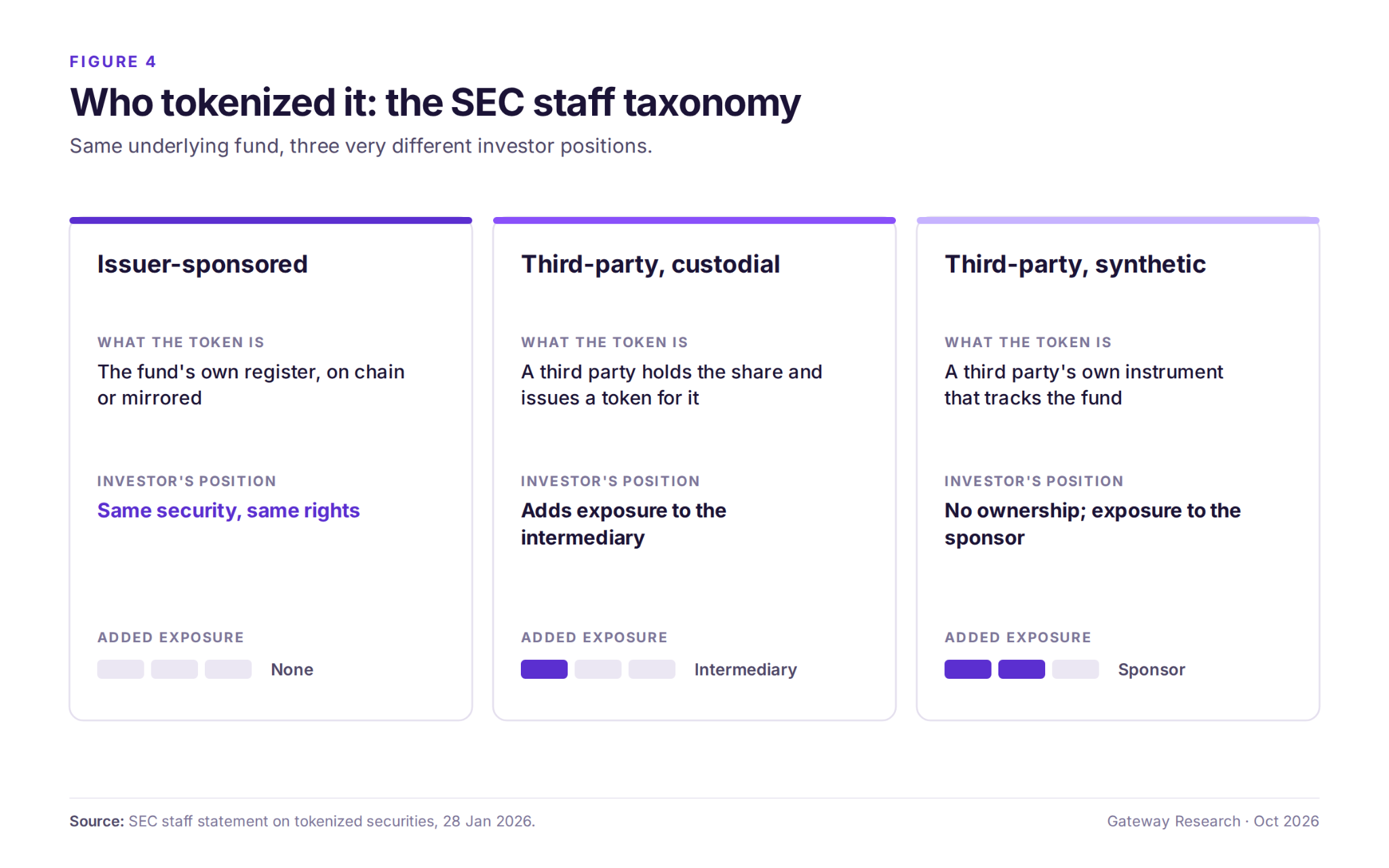
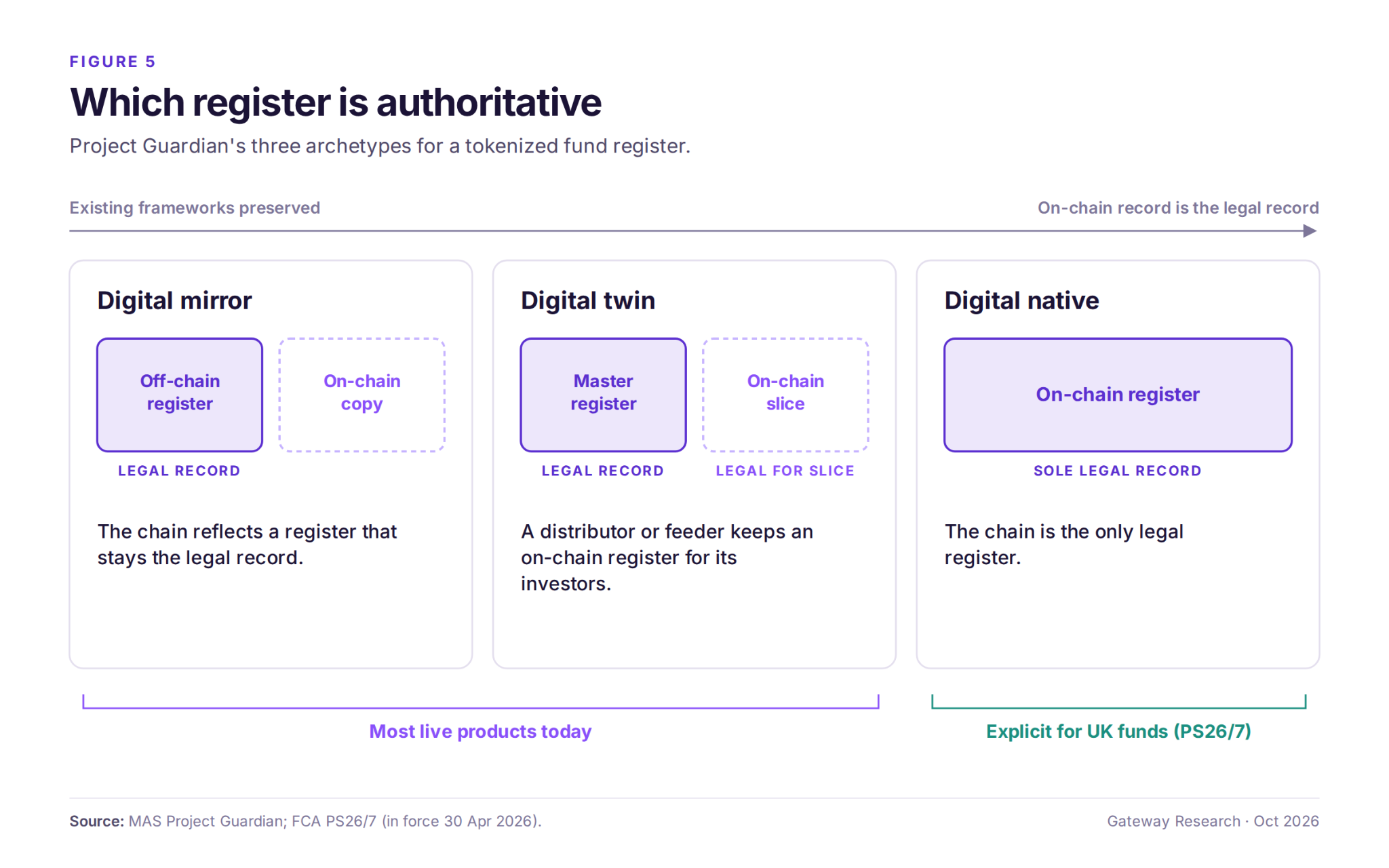
    An issuer-sponsored token on the fund's own register gives investors the same rights as any other share. A third-party token, custodial or synthetic, adds counterparty, operational and insolvency exposure. Singapore's Project Guardian describes a spectrum from "digital mirror" to "digital native" registers.
    The evidence, §5 →
  5. 05The clearest value is collateral and cash management.
    Tokenized money market funds that can be posted as margin and held as stablecoin reserves are the most developed use. ISDA, the CFTC and GENIUS Act rulemaking all point the same way.
    The evidence, §8 →
  6. 06Distribution is the larger prize, and the harder one.
    Reaching new investors requires eligibility, KYC, transfer-agent recognition and venues. Global standard-setters note that the promised secondary-market liquidity has largely not yet materialized.
    The evidence, §8 →
  7. 07The binding constraints are now operational.
    The main obstacles are interoperability across networks, high-quality settlement assets, integration with transfer agents and administrators, and holder privacy. The technology itself is no longer the obstacle.
    The evidence, §12 →
  8. 08Operating-model choices made now will be hard to reverse.
    The choice of register, networks and partners, and who controls them, will shape a manager's flexibility for years.
    The evidence, §11 →
Contents

Four parts, fifteen sections

  1. Part IThe state of the market1. What tokenizing a fund actually means · 2. Size and shape of the market · 3. Who is doing what · 4. What is driving demand5 min · 3 figures
  2. Part IIThe legal and regulatory landscape5. Legal structures: how a fund share becomes a token · 6. Jurisdiction by jurisdiction · 7. The legal questions every program has to answer9 min · 3 figures
  3. Part IIIThe business case8. Where the value is · 9. The economics: who captures the value · 10. Risks and open challenges5 min · 2 figures
  4. Part IVFrom strategy to execution11. Three operating models · 12. The operating work between issuance and liquidity · 13. Holder privacy · 14. A phased path · 15. Ten questions to answer before building5 min · 3 figures
About this report · how it was written and dated

This report is for asset managers, fund boards, product, legal, compliance and operations teams, and the transfer agents, custodians, distributors and banks that work with them. It aims to give a complete, sourced picture of where tokenization of funds and assets stands in late 2026:

  • what is live;
  • how the law treats it in the major jurisdictions;
  • where the business value is, and what remains unproven;
  • what a manager has to decide before building.

It is written to inform, not to persuade. Where evidence is thin or results are still unproven, we say so. Figures are dated, and sources are listed at the end. Figures and developments are updated to 16 November 2026; Figure 2 shows milestones to October 2026. Nothing here is legal advice; a manager should take advice in each jurisdiction where it operates.

1

What tokenizing a fund actually means

Every fund keeps a register of who owns its units. Today that register is a database run by a transfer agent or administrator, and transfers between investors and intermediaries are reconciled across several separate books. Tokenization means recording ownership, in whole or in part, on a shared ledger, so that units can be issued, transferred and redeemed as tokens. Rules such as investor eligibility or transfer restrictions can then be enforced in the transfer itself.

2

Size and shape of the market

Figure 1. The tokenized fund market, November 2026: about $14bn in tokenized US Treasury and money market products across 123 products, about US$1.3bn in Hong Kong tokenized public funds, $4.8bn on Securitize, and the largest products by assets

The market is growing quickly from a small base, and it is concentrated in cash-like products.

3

Who is doing what

Asset managers. The global managers have moved from single pilots to product ranges:

Figure 2. 2026, the year the legal path cleared: selected regulatory, market-infrastructure and product milestones from December 2025 to October 2026

4

What is driving demand

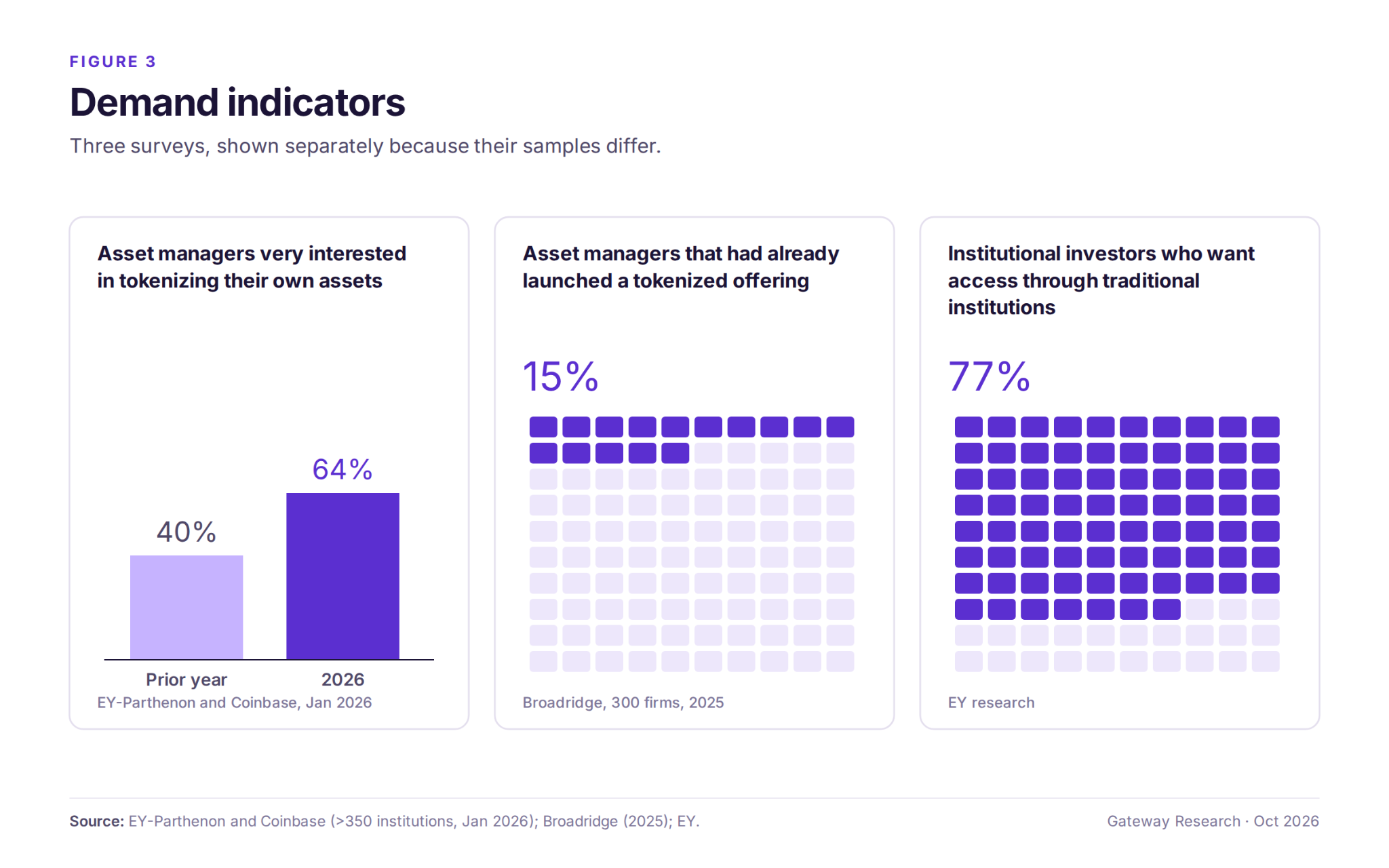
Demand now comes from specific buyers with specific needs, not from general interest in blockchain.

Figure 3. Demand indicators from three surveys: 64% of asset managers very interested in tokenizing their own assets, 15% already launched, 77% of institutional investors wanting access through traditional institutions

Up next · Part IIThe legal and regulatory landscape9 min · 3 figures →
6

Jurisdiction by jurisdiction

Figure 6. The legal landscape by jurisdiction: United States, United Kingdom, European Union, Singapore, Hong Kong and UAE

The US moved from uncertainty to an active, if still interim, framework in 2026.

Up next · Part IIIThe business case5 min · 2 figures →
8

Where the value is

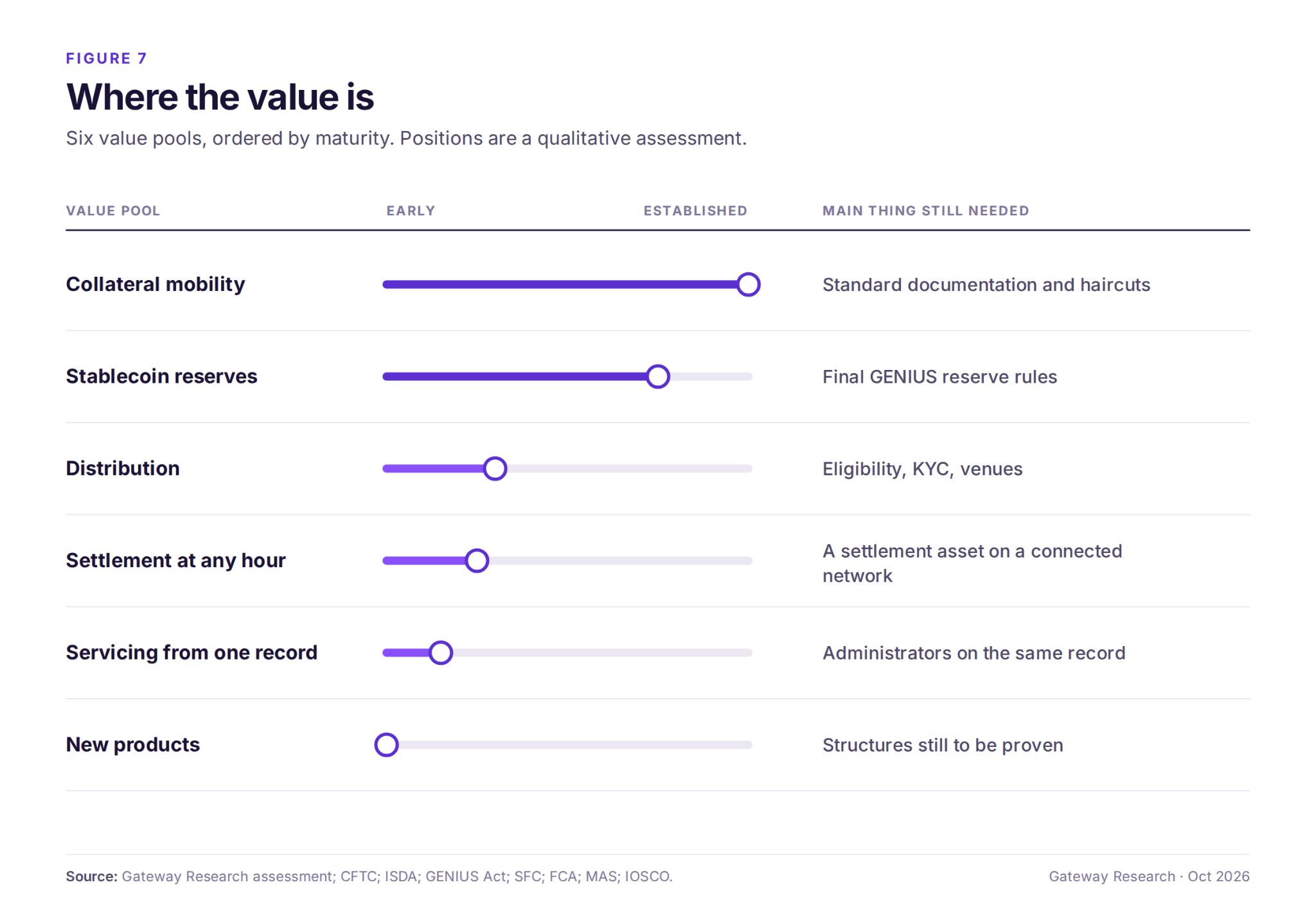
Tokenizing a share class creates value only if the token can do something the traditional share cannot. Six value pools are emerging. They differ sharply in maturity.

Figure 7. Six value pools ordered by maturity, from collateral mobility to new products, with the main thing each still needs

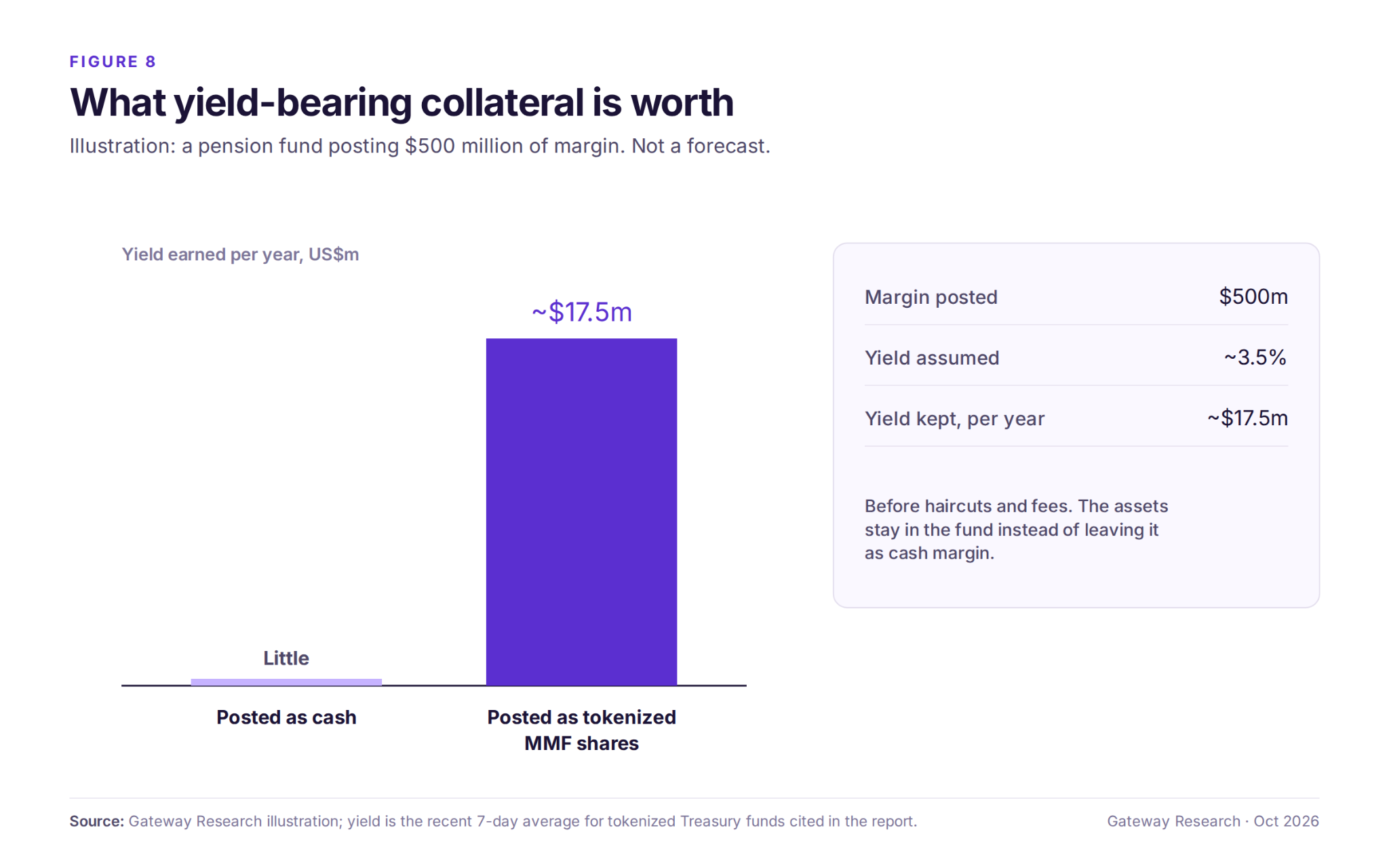
Figure 8. Illustration: $500m of margin posted as tokenized money market fund shares at about 3.5% keeps about $17.5m a year in yield, before haircuts and fees

9

The economics: who captures the value

Tokenization redistributes economics along the value chain. Citi's June 2026 report expects "structural orchestrators" to emerge: institutions that control issuance, distribution and settlement rails.

10

Risks and open challenges

A balanced view requires the risks too:

Up next · Part IVFrom strategy to execution5 min · 3 figures →
11

Three operating models

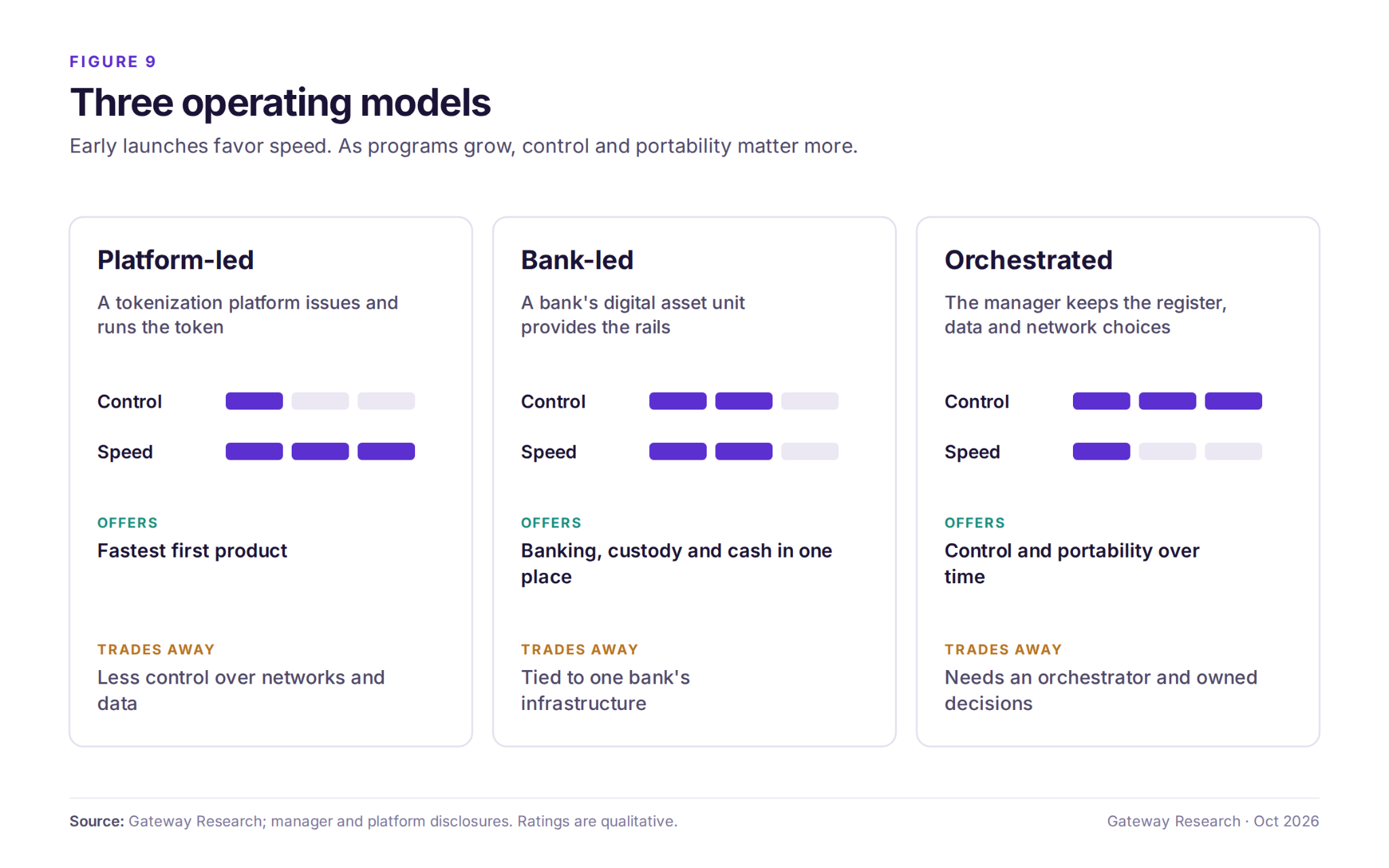
Managers that have launched so far have used one of three models.

Figure 9. Three operating models compared on control and speed: platform-led, bank-led and orchestrated

12

The operating work between issuance and liquidity

13

Holder privacy

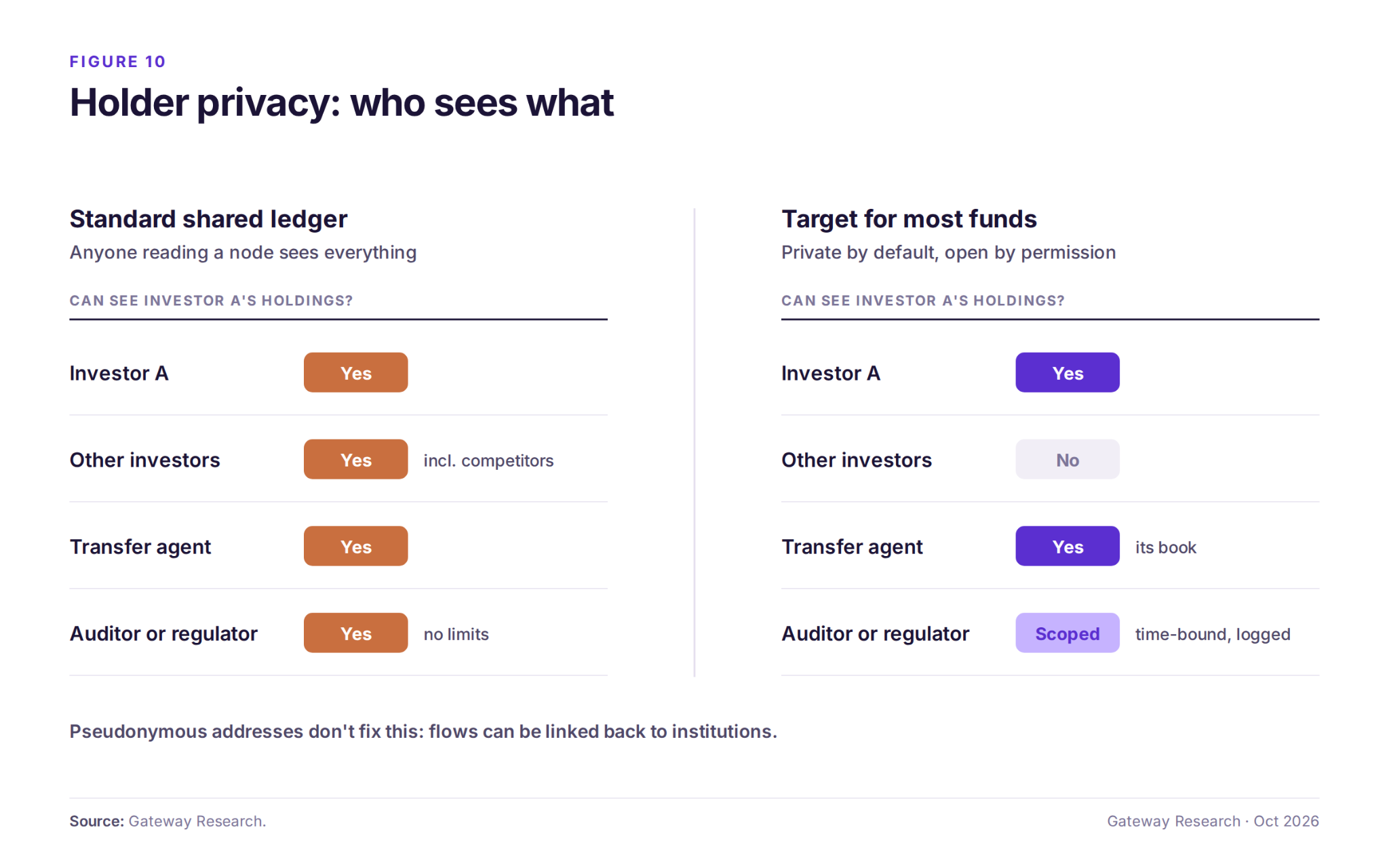
On a standard shared ledger, anyone reading a node can see every holder's balance and every transfer. For a fund, that exposes who its investors are, the size of their positions, when they subscribe or redeem, and how the manager moves collateral. Pseudonymous addresses do not solve this, because flows can be clustered and linked back to institutions. That conflicts with a manager's duty of confidentiality to its clients, leaks market information, and gives supervisors no better view than anyone else.

Figure 10. Holder privacy: on a standard shared ledger everyone sees investor holdings; the target for most funds is private by default with scoped, time-bound regulator access

14

A phased path

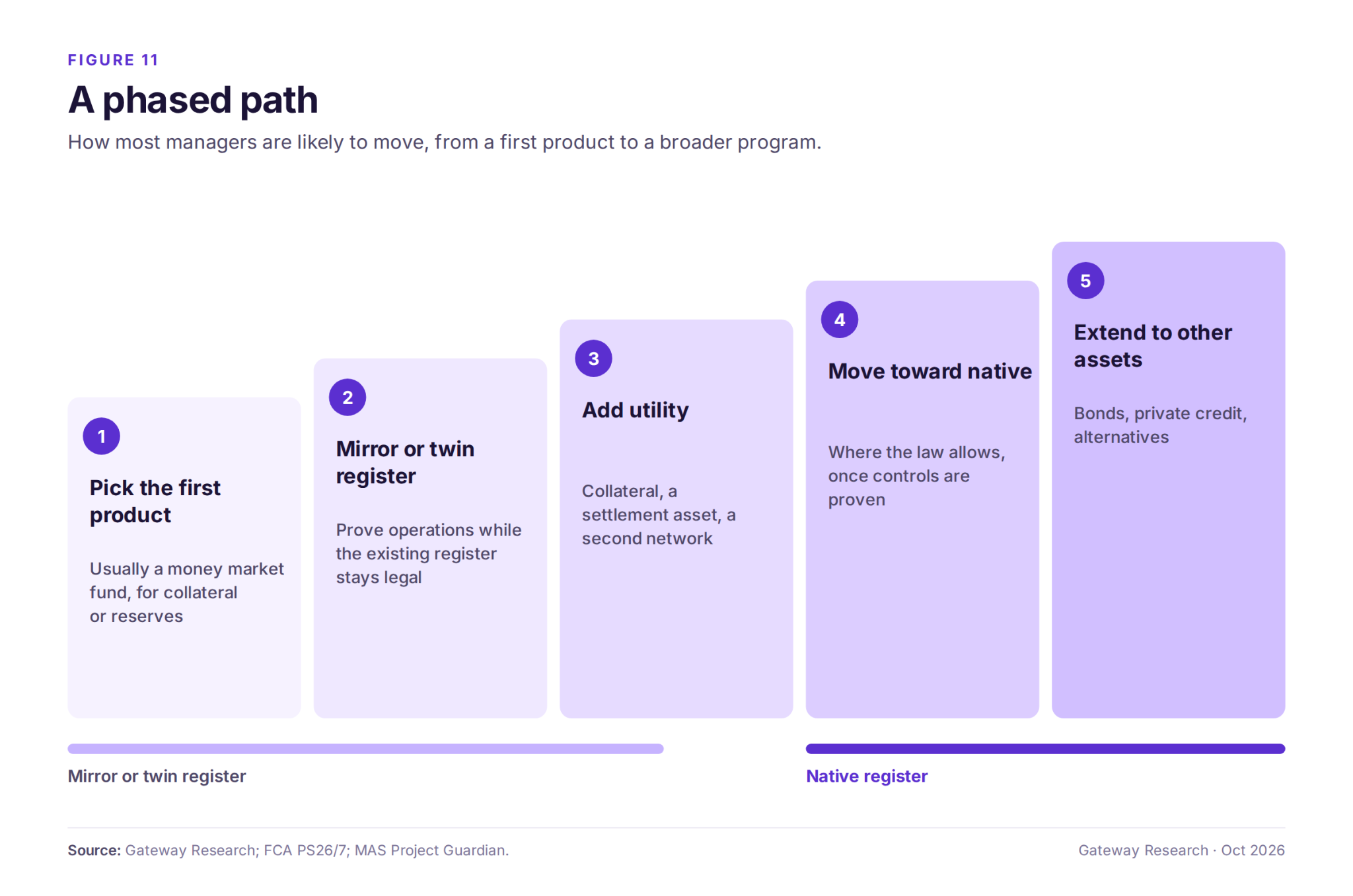
Most managers will move in stages:

Figure 11. A phased path in five steps, from a first product on a mirror or twin register to a native register and other asset classes

15

Ten questions to answer before building

Reference
Glossary
  • Digital mirror / twin / native: Project Guardian's register archetypes, from an on-chain copy of an off-chain register to an on-chain register that is the legal record.
  • Issuer-sponsored token: a token issued by, or on behalf of, the issuer, carrying the same rights as the security.
  • Custodial token: a third party's token representing a security entitlement in a security it holds.
  • Synthetic token: a third party's own instrument giving economic exposure without ownership.
  • D2F: the UK's optional Direct to Fund dealing model.
  • DvP: delivery versus payment, where the asset and cash legs settle together.
  • Settlement asset: the cash used to settle: tokenized deposits, regulated stablecoins or central bank money.
  • TMMF: tokenized money market fund.
Sources

Regulators and standard-setters:

Market and industry:

Law firm and secondary analysis used for detail:

This report is for information only and is not legal, tax or investment advice.