Tokenised Deposits: The Other Chain Is a Bank
What Are Tokenised Deposits?
TL;DR for Crypto People
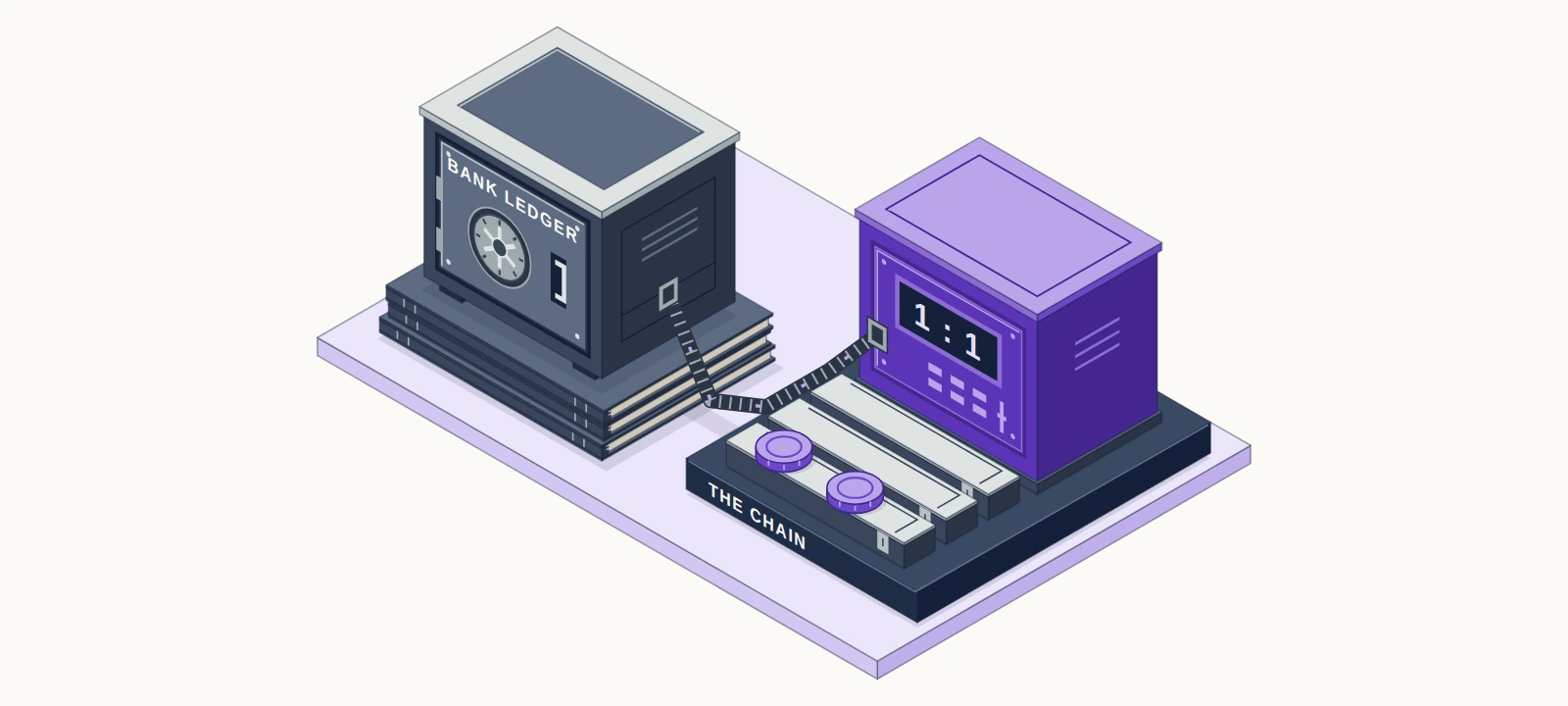
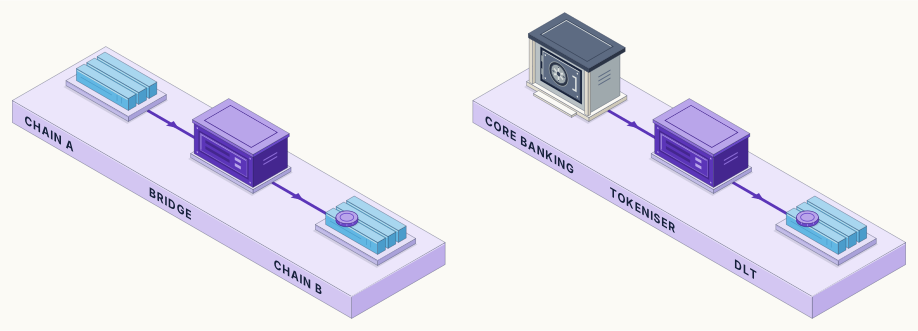
A tokenized deposit is a bridge. Not as a metaphor — in the ordinary technical sense, the one you would use for Ethereum and Solana. Two ledgers. Lock on one, mint on the other, burn to unlock.
What makes it interesting is the far side. It is not another chain. It is a core banking system: a ledger with different finality, a different consensus mechanism, and opening hours.
Everything that feels strange about tokenised deposits — and everything that makes them useful — follows from the properties of that other ledger.
Tokenised deposits are blockchain-based representations of traditional bank deposits: standard bank balances turned into programmable digital tokens that can be transferred instantly, used in smart contracts, or composed with other onchain applications — while remaining fully backed 1:1 by fiat held in a regulated bank.
An example. A customer deposits $10,000 at Bank X. The bank issues 10,000 tokens (1 token = $1), fully backed by the deposit. To pay a landlord $2,000, the customer sends 2,000 tokens to the landlord's wallet in seconds — at midnight if they like. The landlord can hold the tokens as digital cash, redeem them for dollars, or pay suppliers through automated smart contracts, without touching banking hours or correspondent chains.
For banks, the same mechanics work wholesale: if Bank X owes Bank Y $5 million, it transfers 5 million tokens in one click instead of waiting on interbank clearing.
The Money Does Not Leave the Bank
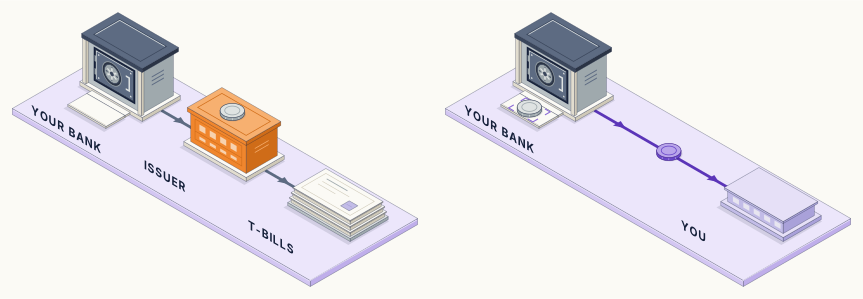
Say you hold a deposit and the bank tokenises it.
The bank places a hold on the balance: the money stays exactly where it was, the available amount drops, and tokens are issued to you for the same amount. From your seat it feels like the money left your account. What actually left is your ability to draw it as cash. You are holding the same claim in a different form.
Two consequences fall out of that.
There is no reserve. Because there is no need to. Nothing was bought. The hold exists so the bank cannot promise the same money twice — once as cash over the counter, once as a token in circulation. That single control is what the product rests on, and it is the first thing a bank operator audits.
The bank keeps lending against your deposit while you hold the token. That is the fractional-reserve part, and it is also why a deposit token can pay you interest and a stablecoin cannot: a stablecoin issuer holds reserves it may not lend, and the US framework bars it from paying holders yield directly.
The Other Ledger
Treat a core banking system as a chain and its specification reads like this:
- Consensus is a regulator and a body of law. Not a majority of anything.
- Finality arrives when a transfer can no longer be unwound by an administrator, a court or an insolvency. It is a legal fact, not a depth in blocks.
- Transactions are reversible by design: recalls, chargebacks, court orders, corrections. The operators are required to have this.
- The validator set is one entity, and it is liable for what it validates.
- Block times are a batch window, and there are opening hours.
- State is private by default and disclosed under authority.
Read that list as a set of requirements rather than as a joke, and most of the design decisions in a deposit-token platform stop being surprising.
What Tokenisation Actually Buys a Bank
With the mechanics in place, the operational gains follow directly:
Unified liquidity. If tokenization is adopted fully, deposits, securities and other instruments sit on one shared ledger, so value moves between them without intermediaries or batch windows. Funds stop being trapped in isolated accounts.
Operational efficiency. One shared ledger replaces the constant reconciliation of parallel databases — fewer errors, less administrative overhead, faster processing at lower cost.
Simplified governance. Permissioned networks run on predefined digital rules. Decisions and updates that currently require committees of intermediaries execute as configuration.
Stronger oversight. Participation is restricted to licensed, verified institutions, and every transaction is recorded. Regulators get real-time visibility into money flows instead of retrospective reporting. Especially when using something like Open Privacy Suite, which makes selective disclosure access trivial: purpose-bound, approved, time-limited, and logged.
Programmability. Smart contracts execute transfers, interest payments, collateral movements and redemptions automatically — invoice payments on delivery, instant collateralisation, scheduled sweeps.
Instant settlement. Payments and asset transfers finalise in real time, 24/7, cutting settlement risk and freeing working capital — especially cross-border, where correspondent banking adds days and fees. When using something like a private Besu chain, the finality is minutes, and when using a high-performance L2 the finality can be in milliseconds.
Bank-Local Money — and the Second Bridge
Here is the part most marketing material skips. The set of people you can pay with a single bank's deposit token is the set of that bank's customers.
One issuer's token is an app-chain with no bridges out. Perfect internal liquidity, zero external reach.
So, settle instantly, at any hour, with counterparties who happen to bank where you bank.
In crypto, bridges are the interoperability layer — the thing that stops each chain being an island.
Ironically, from the technical perspective, here the bridge is the island.
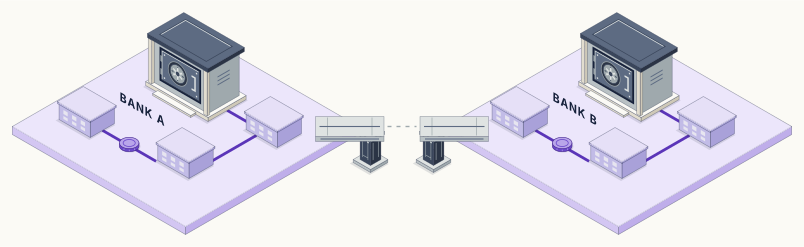
That is why the industry's real work in 2026 is not the token. It is the rulebook between issuers: redemption at par, when a transfer is final, who eats a loss, what hours the thing runs, how a participant leaves.
In June 2026 a dozen of the largest US banks announced they would build exactly that, targeting 2027.
It is an interoperability layer with a governance problem rather than a technical one — the same cold-start dynamic as any rollup ecosystem, run by institutions that move slower and have more lawyers.
What Inverts
Five mental models flip on the way in. Each of them has stalled a good proposal.
Immutability is a liability. Banks need reversals, recalls, disputes, frozen accounts, deceased account holders, court orders. "Code is law" is not a feature here — it is unmanaged operational risk. Build for correction.
Self-custody is a risk, not a right. A corporate treasurer does not want the keys. They want a supervised institution on the hook when it goes wrong. Key management is a cost they are paying someone else to absorb.
Chain finality is not settlement finality. Chain finality is probabilistic, then economic. Settlement finality is legal: the point after which an administrator, a court or an insolvency cannot unwind the transfer. A committed block does not answer that question, and the two words sound identical in a meeting.
Atomicity stops at the bank's door. Inside one ledger, delivery-versus-payment works. Between a chain and a core banking system there are two ledgers, an ordering, and an exposed half-state. Mint before the hold and the tokens can exist against money that is still withdrawable; burn before the payout and the tokens are gone while the money sits. A design that promises cross-system atomicity has a queue somewhere.
Transparency is a leak. Public-by-default is worth defending in most of crypto. On a shared bank rail it exposes a customer's payment flows to their competitors.
Privacy
That last inversion is why the problem is still open. A shared rail creates reach and a confidentiality problem in the same move. Several banks and their customers on common infrastructure means balances, counterparties and flows are visible to participants who are also competitors.
No corporate runs payroll or supplier payments where a rival can watch.
Permissioned networks control who joins; they do not protect the data layer.
Three properties are needed at once:
- Confidential — other participants see no amounts, balances or holdings.
- Provable — the bank still demonstrates that every token is backed.
- Disclosable — a supervisor sees a named transaction, on a named approval, with an expiry and a record of what was shown.
A public chain does the second well.
A private database does the first two trivially. All three together is much more complicated.
That line is not a rhetorical flourish.
It is the design brief of Open Privacy Suite, Gateway's privacy and controls layer: a JSON-RPC proxy that sits between authenticated applications and an EVM node and enforces who is allowed to see and do what — no proprietary node protocol required.
Views are organization-aware and role-aware, down to individual call parameters, and the same policy shapes RPC responses and the block explorer, so list and count surfaces cannot leak the rows they hide. Every delivered view is recorded as evidence: who saw what, when, under which approval.
Disclosure is a first-class workflow.
A supervisor can be granted access to named data under an explicit, time-limited approval — full identity for an investigation, consistent pseudonyms for an audit that still show transaction-graph patterns, or proof of activity with no counterparty correlation at all. The grant, the access and the expiry each leave a record.
The chain state itself is not hidden from its node operators. The guarantee holds when every node of the chain sits behind the proxy or is unreachable from users. Inside that boundary, the three properties above stop being a research programme and become configuration. That is true as of Sep 2026, but we are currently solving it, so if you are reading it way later — it might be already completely solved.
One more constraint, easy to design straight past: under the Basel cryptoasset rules, a tokenised bank claim can follow the underlying deposit's treatment — that is what keeps it capital-neutral — but claims whose holders cannot be identified can attract worse liquidity treatment. So privacy here cannot mean the bank does not know who holds it. It means the bank and its supervisor know, and other participants do not. Get that backwards and the product dies at the treasury desk on capital grounds, before compliance has read it.
Why Banks Are Doing This Now
One number carries the budget. A billion dollars of corporate operating balances, priced internally at a 3% funds-transfer spread, is worth about thirty million a year. Stablecoins made those balances contestable, the US wrote a federal framework for them in July 2025, and banks are responding with the one product that keeps the balance on their own books.
Everything else — settlement certainty, programmability, the cash leg for tokenised securities — is real, and secondary to that.
If You Are Building One
Building a proprietary chain from scratch is impractical for most banks: the investment in talent, infrastructure and security, plus the operational burden of 24/7 uptime, makes it prohibitively costly and risky. But buying a generic wrapper will not survive contact with the list above either.
If you are building one — or looking to build one — talk to us first.
We have built one: the whole lifecycle, deposit through partial redemption, with private views on the chain, supervisory access under approval, and an answer written against a real bank's questionnaire. Reach out.
What proves nothing: 14,200 transactions a second on a testnet, a 380 ms block time, a $12.50 transfer between two wallets the demo team owns, an explorer tour, a cross-chain bridge, a key ceremony, 99.98% uptime measured over eleven days, and any "atomic settlement" where the bank leg still lands tomorrow.