Gateway for Sovereign Onchain Finance
For nearly six years, Gateway has worked at the infrastructure layer of blockchain: deploying networks, operating production systems, processing institutional workloads, managing validators, engineering migrations and supporting environments where availability, performance and recovery are operational obligations rather than marketing claims.
The market initially encountered Gateway through RPC, indexing and RaaS (Rollup-as-a-service) infrastructure. That description reflected an earlier stage of the company, but it no longer captures what Gateway has built.
The technology stack now extends across sovereign network deployment, heterogeneous interoperability, privacy architecture, identity and policy enforcement, regional infrastructure, data residency, migration, institutional product infrastructure, security evidence and integration with regulated financial services. Gateway’s engineering capability, partner network and operating experience have converged into a single institutional proposition.
Today, Gateway is making that position explicit:
Gateway is the institutional infrastructure orchestrator for sovereign onchain finance.
This is the institutional application of the infrastructure Gateway has spent years building. The original thesis was always that blockchain would eventually move beyond isolated networks and become part of the financial operating system. The market has now reached the point where that thesis can be implemented.
A market inflection nearly six years in the making
The first institutional phase of blockchain was defined by technical validation. Banks, central banks, market infrastructures and technology providers tested whether distributed ledgers could record ownership, coordinate settlement and support programmable financial instruments.
The second phase introduced products: stablecoins, tokenized deposits, bonds, funds, securities, private credit and new forms of digital collateral.
The market is now entering a more consequential phase. Financial institutions are no longer asking only whether an asset can be issued onchain. They are deciding how that asset will operate across custodians, investors, liquidity providers, payment systems, regulators, insurance, auditors and existing books and records.
That changes the infrastructure requirement completely.
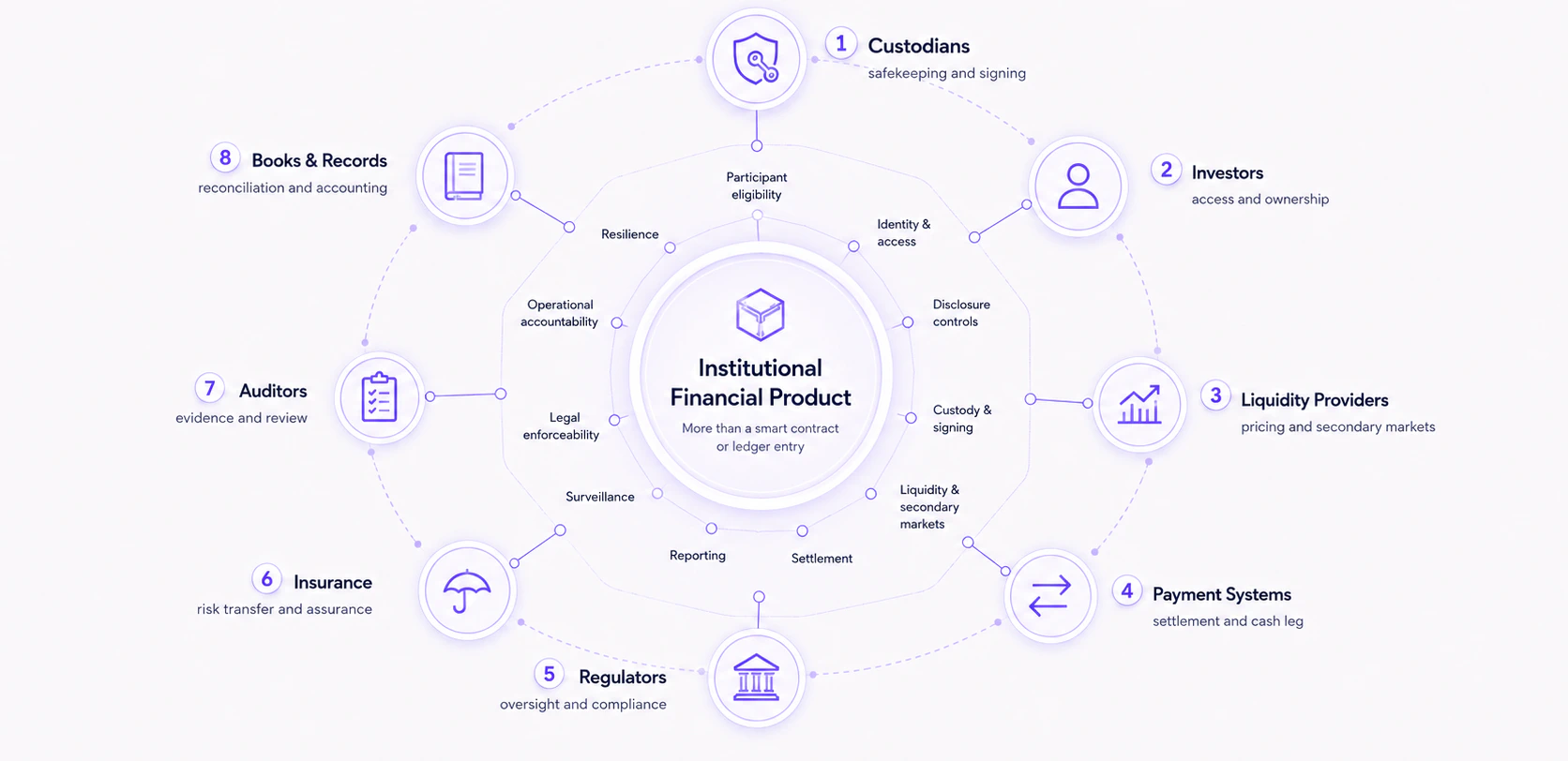
An institutional financial product cannot be reduced to a smart contract or a ledger entry. It requires a controlled operating environment around the asset: participant eligibility, identity, access, disclosure, custody, signing, liquidity and secondary markets, settlement, reporting, surveillance, legal enforceability, resilience and operational accountability.
This transition will not be completed in one market cycle. The financial system will operate through a hybrid architecture for much of the next decade. Core banking systems, central securities depositories, public blockchains, permissioned ledgers, bank-controlled networks and new settlement rails will coexist.
The infrastructure that matters will be the infrastructure capable of supporting that journey, not only demonstrating a new ledger, but connecting it to the institutional systems, controls and markets required for production.
Introducing Sovereign Networks: the architecture of retained institutional authority
Gateway uses the term sovereign network deliberately.
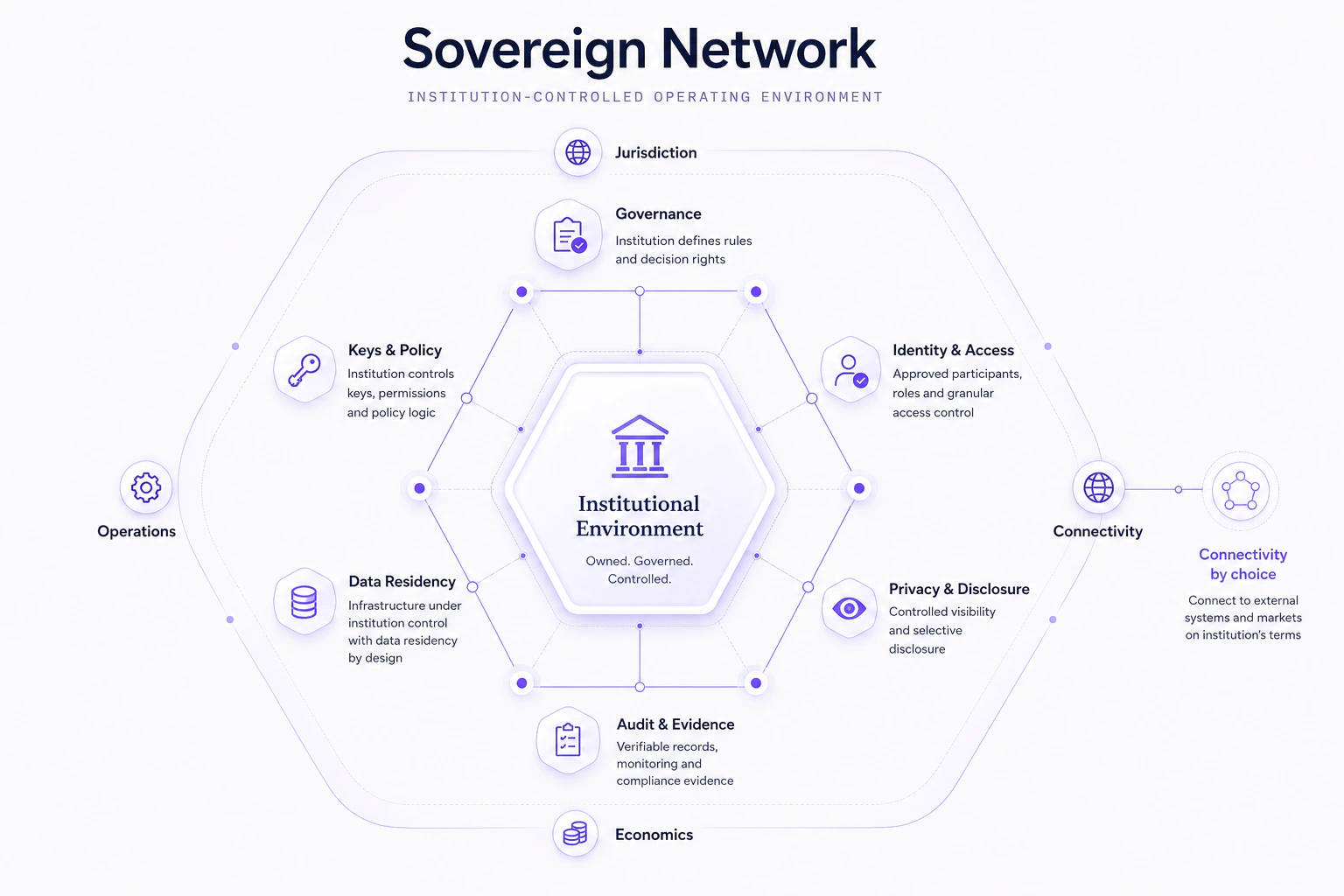
A sovereign network is a controlled financial infrastructure environment designed around an institution’s regulatory, operational, geographic and commercial requirements. The institution retains authority over the elements that define the system: governance, keys, policies, participants, economics, data, jurisdiction and connectivity.
This is broader than a private blockchain or private networks.
A private network generally defines a closed environment: who may participate, which systems are accessible and what information remains visible within that perimeter. In conventional technology architecture, it resembles an intranet; an internal network accessible only to authorised users and systems.
Sovereignty describes something more extensive. It covers control over the complete digital domain: where infrastructure is deployed, who administers it, which identities may act, how permissions are enforced, what evidence is produced and how the environment connects to counterparties, external systems and public networks.
The distinction is important. A private blockchain may restrict access while still depending on infrastructure, governance or administrative controls that sit outside the institution’s authority. A sovereign network places those decisions within an institution-defined operating model.
Interoperability Across Multiple Financial Environments
The institutional market will not converge on one universal blockchain. The Global Financial Market will operate across multiple sovereign environments.
Commercial banks, payment companies, securities infrastructures, asset managers, governments and fintechs operate under different legal mandates, risk tolerances and settlement models. Their infrastructure choices will reflect asset type, geography, data sensitivity, participant structure, regulatory perimeter and commercial strategy.
Dedicated sovereign networks will provide institution-defined governance, privacy, access and data control. Public networks will continue to provide liquidity, distribution, settlement and open participation. Existing financial infrastructure will remain part of the transaction chain throughout the transition.
The market will therefore remain hybrid and the resulting architecture will be plural by design.
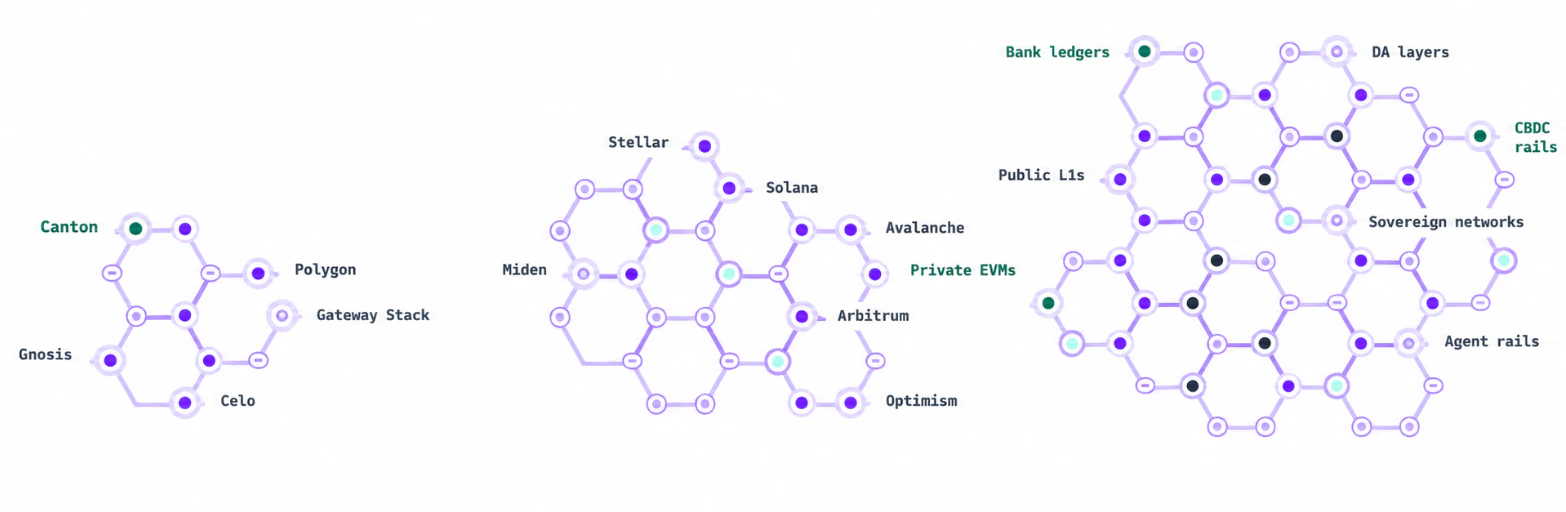
Beyond those bilateral or consortium connections, the institution may also choose public networks for distribution, liquidity, open settlement and access to broader markets. Sovereignty gives them the ability to participate selectively: determining what remains within the institution, what is shared with approved counterparties, what reaches public infrastructure and which policies govern each movement of data or value.
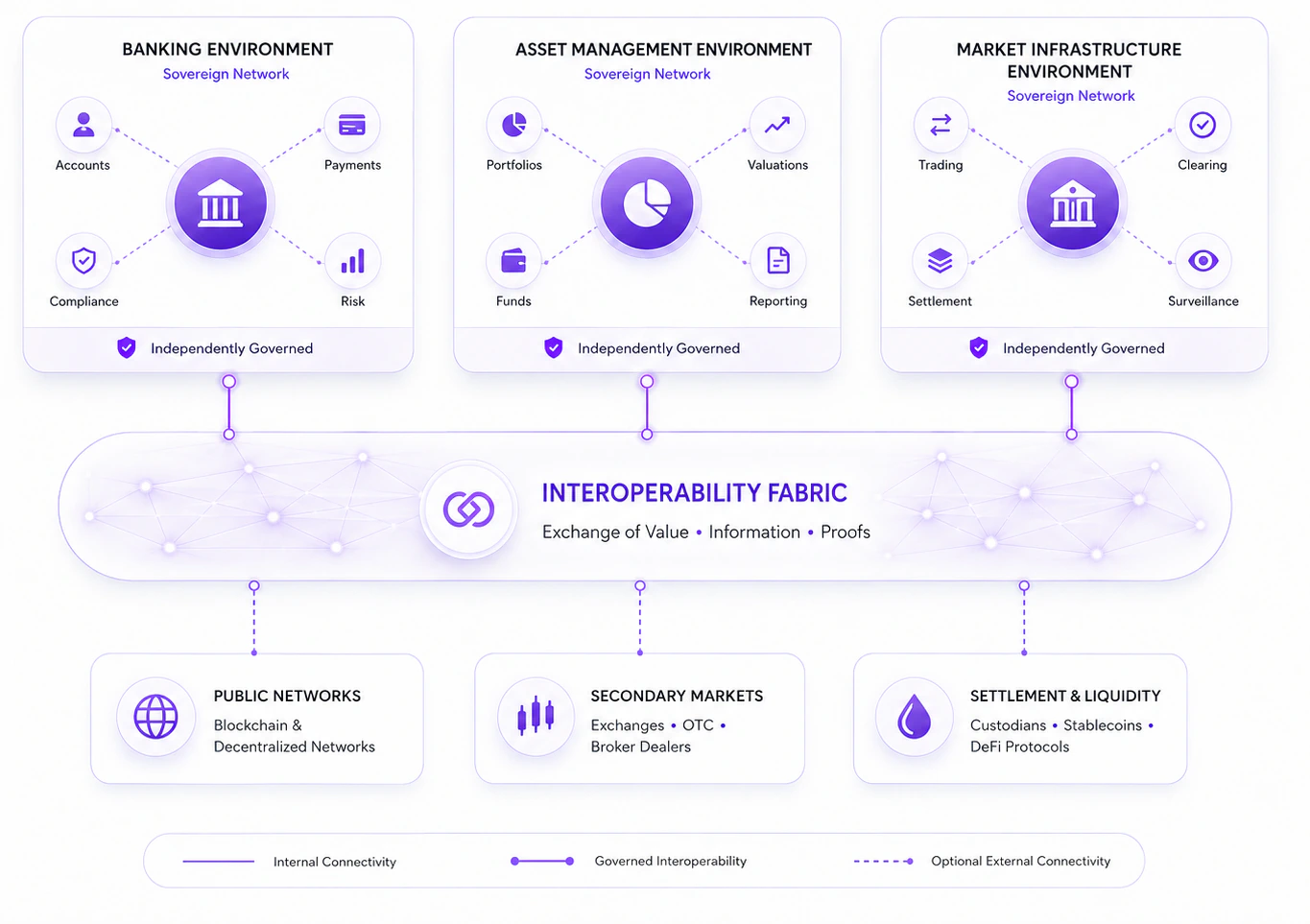
The closest analogy is therefore not that a sovereign network is itself the internet. It is that the institution controls its full network architecture: the private intranet where internal activity takes place, the governed extranet through which selected counterparties are reached, and the gateways through which approved activity can connect to the wider internet-like public layer.
Within a sovereign environment, private activity can remain inside an institution-controlled intranet. Payments, records, balances and internal workflows do not need to leave that perimeter when there is no commercial or regulatory reason for them to do so.
The principal risk is not the existence of multiple networks. It is allowing them to become disconnected financial islands.
This is why sovereignty and interoperability must be developed together.
Sovereign networks provide institutional control. Sovereign interoperability provides the governed extranet between independently controlled environments. Public connectivity provides optional access to open markets without requiring the institution to move its entire operating environment onto public infrastructure.
Each network retains its keys, policies, participants, data and jurisdiction. The connection between them must respect the authority on both sides.
Introducing The Gateway Architecture: Platform, privacy and orchestration
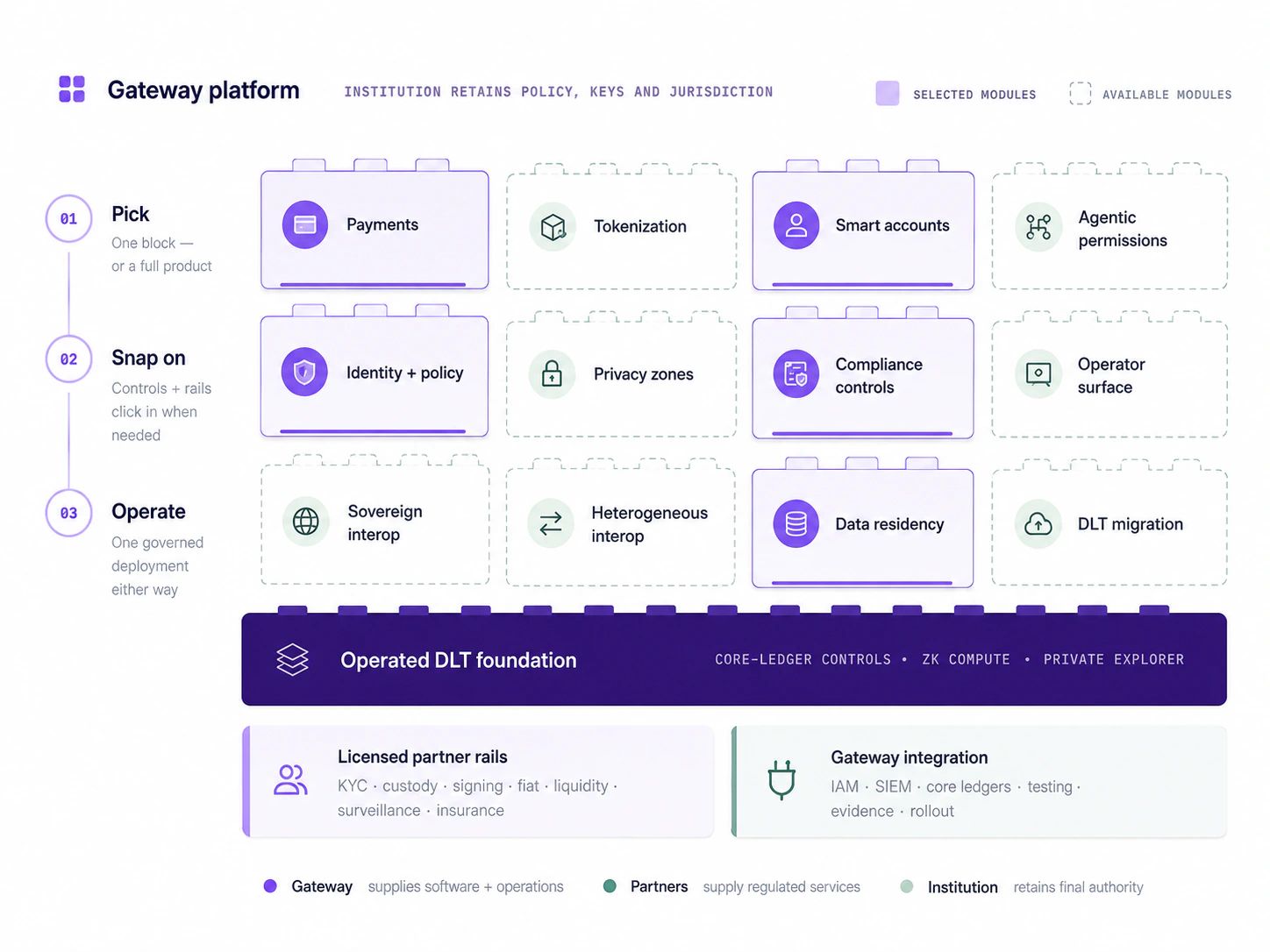
Gateway’s role is not to replace every system an institution already operates, or to rebuild every specialist financial capability inside one proprietary stack. The model has three core components: Gateway Platform, Gateway Orchestration, and Open Privacy Suite.
The Platform provides the Gateway-owned technical foundation. Open Privacy Suite introduces controlled visibility and policy into institutional EVM environments. Orchestration connects that technology with the specialist capabilities, existing institutional systems and operating responsibilities required to bring a financial product into production.
Gateway Platform: the technical operating foundation
Gateway Platform is composable infrastructure for sovereign onchain finance. Institutions can introduce individual capabilities around an existing technology estate or combine them into a broader production environment without surrendering authority over the financial product.
The Platform spans multiple capability domains:
DLT & protocol foundation: The network and execution environment beneath the product, from EVM infrastructure and dedicated institutional networks to settlement foundations and connections into existing DLT estates.
Managed environments: Production infrastructure across cloud, regional, institution-controlled, on-premises and hybrid environments, including RPC, indexing, validators, data infrastructure and managed network operations.
Interoperability & data: The connectivity required to move information, instructions and assets between independently governed networks and systems, alongside the signed data and external inputs financial applications depend on.
Privacy, identity & controls: The policy layer governing who can participate, what they can do, what they can see and what evidence is retained around those decisions.
Agentic Finance: Agentic Finance Framework extends identity, access and policy controls to machine actors. Its emerging agentic layer includes x402 payment flows, AI Firewall controls, agentic wallets and Know Your Agent capabilities.
The important point is not that every institution needs every capability. The Platform is modular in adoption, but unified in operation. The architecture is selected around the institution’s financial requirement, existing systems, jurisdiction and control model.
Open Privacy Suite: controlled visibility for institutional finance
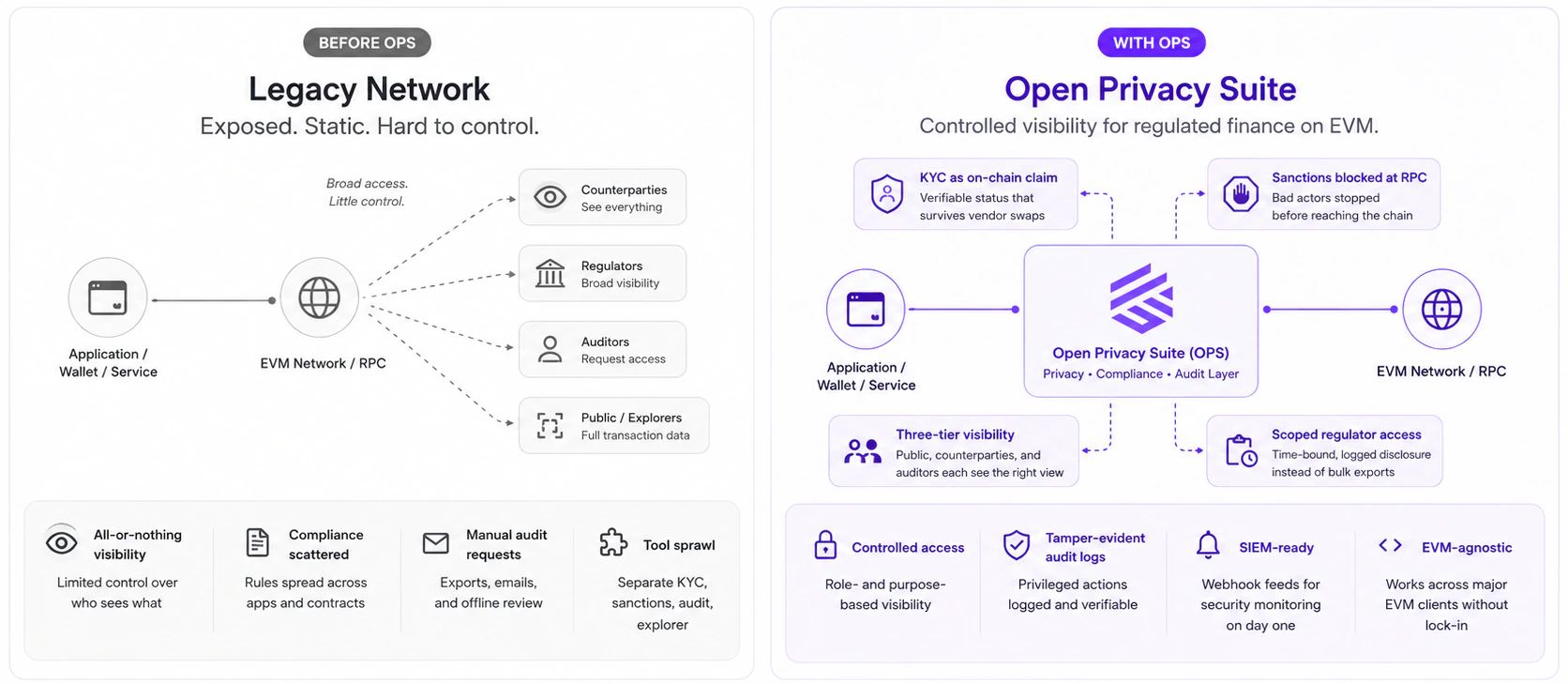
Privacy is one of the clearest examples of why institutional onchain infrastructure cannot simply inherit the operating assumptions of public blockchain systems.
A financial institution may need multiple parties to operate against the same ledger without exposing every balance, transaction, position or customer relationship to every participant.
Gateway’s Open Privacy Suite introduces a policy and visibility layer into compatible EVM environments.
Instead of network access determining what information a participant receives, an authenticated request can be evaluated against identity, role, purpose and policy before the authorised view is returned.
That allows the same underlying environment to support different visibility outcomes:
- full access where authorised;
- consistent pseudonymous views where identity should remain protected;
- redacted information where disclosure is not permitted;
- time-bound selective disclosure for approved recipients;
- and evidence of the access and disclosure decisions that were applied.
The objective is straightforward:
define who can act, who can see, what can be disclosed, and what can be evidenced.
This turns privacy from an application-level workaround into part of the operating architecture of the financial product.
Gateway Orchestration: assembling the complete institutional environment
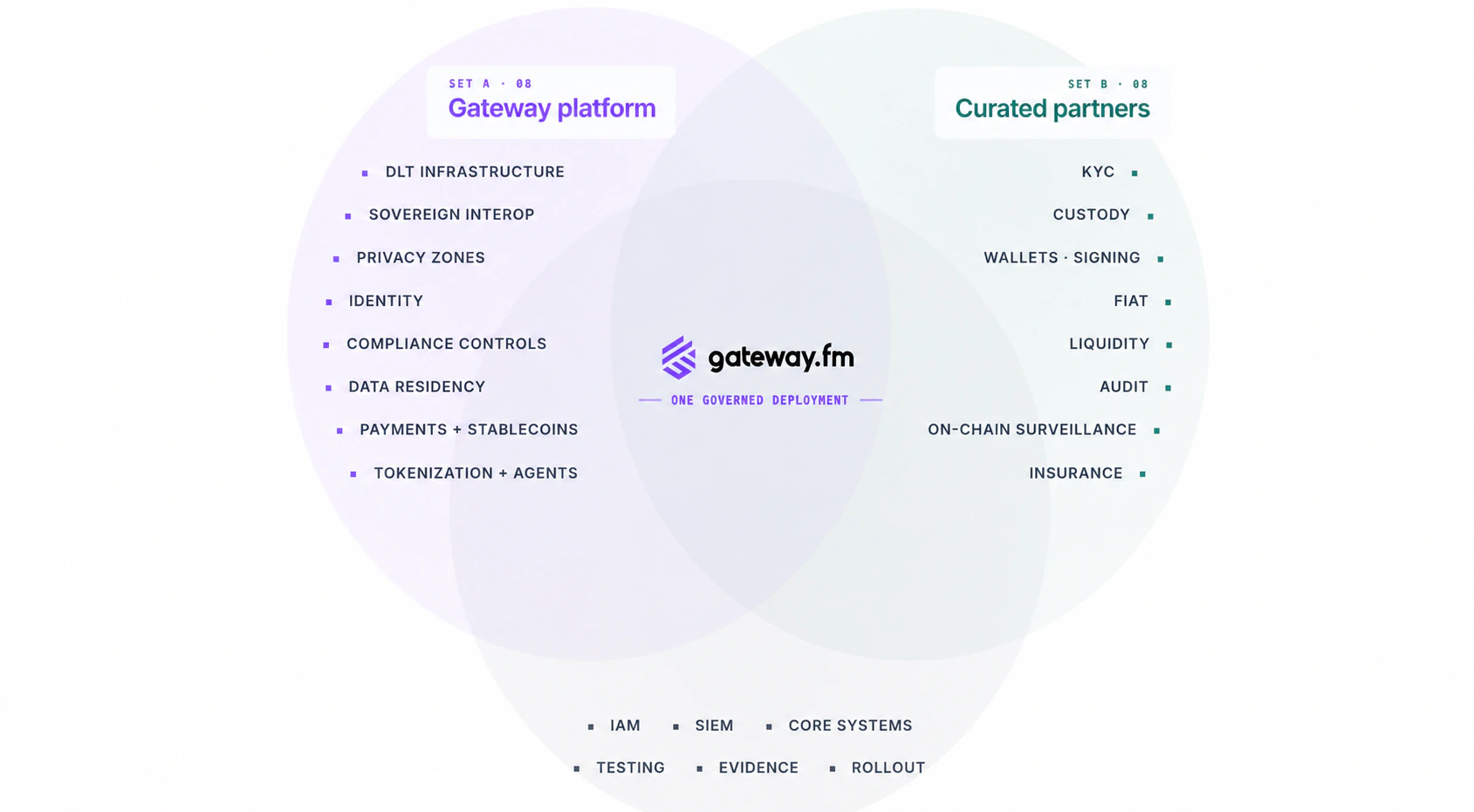
The strongest institutional financial systems will not be built by one infrastructure company attempting to own every layer. They will emerge from complementary technology, financial capabilities, market expertise and distribution being assembled around real institutional requirements.
The Gateway orchestration model incorporates specialist and regulated providers across:
- KYC / KYB;
- custody and programmable key management;
- institutional wallets and signing;
- fiat on- and off-ramps;
- banking and payment connectivity;
- liquidity and institutional OTC;
- secondary-market access;
- onchain surveillance;
- reserve monitoring and attestation;
- smart-contract and protocol audit;
- legal and regulatory support;
- and insurance.
Many of these capabilities are already provided by specialist companies that are better positioned to deliver them. Gateway does not need to rebuild those functions.
Gateway Orchestration coordinates them.
Orchestration also changes how Gateway approaches partnerships. Therefore, Gateway is building different forms of collaboration across the ecosystem.
1. Gateway and EthSystems: advancing confidential institutional finance
Gateway is partnering with EthSystems to advance the confidential-finance use cases institutions are beginning to evaluate across payments, assets, markets and identity.
EthSystems is developing a working knowledge base for confidential institutional Ethereum, organised across payments, funds and assets, trading, identity and compliance, and private data and oracle infrastructure. Its published use cases include private FX, private payments, institutional stablecoins, private treasury operations, bonds, money-market funds, RWA tokenization, repo, derivatives, private identity, authoritative registries and confidential blockchain reads.
This collaboration connects education and awareness material, use-case research and privacy architecture with Gateway’s production infrastructure and a shared commitment to package research into products for wide scale institutional adoption.
Explore the confidential-finance use cases with EthSystems.
2. Institutional workshops and market education
Technology implementation often starts much earlier than architecture.
Institutions first need to understand which financial problems are appropriate for onchain infrastructure, what operating models are available, where privacy or interoperability constraints emerge, and which assumptions should be tested before committing to production.
Gateway is developing institutional workshops and educational programs with ecosystem organisations including EthSystems, the Enterprise Ethereum Alliance and regional partners such as TEIZA.
These engagements are intended to move institutions from broad market interest toward a defined financial requirement that can be researched, architected and, where appropriate, validated through a proof of concept.
3. Specialist capabilities
The same partnership model extends into technical and financial infrastructure.
Gateway’s public ecosystem currently includes collaborations across areas such as:
- Breach Insurance for exploring insurance and risk;
- FinchTrade for liquidity and markets;
- Axiology for digital capital-market infrastructure;
- TEIZA for regional market access and ecosystem development;
- and EthSystems for institutional financial use cases and research.
The relevant capabilities are selected according to the financial product, jurisdiction, institutional requirements and operating model.
That is what Gateway as the institutional infrastructure orchestrator for sovereign onchain finance means in practice.
It is a modular sovereign architecture designed around the institution’s product, jurisdiction and control model, but operated as one production system, with coordinated integration, evidence and support across every layer.
Pradeep RV Singh, Co-founder and CEO of Gateway:
“The market has reached the point where blockchain infrastructure must carry real financial responsibility. Institutions need control over their data, policies, economics and operating environments, while remaining connected to liquidity, insurance, settlement systems and counterparties outside those boundaries. Gateway has spent nearly six years building and operating the infrastructure required to reconcile those demands. Sovereign onchain finance is the architecture that brings them together.”
An institutional position earned in production
Gateway’s authority in this category begins with an operating record, not a roadmap.
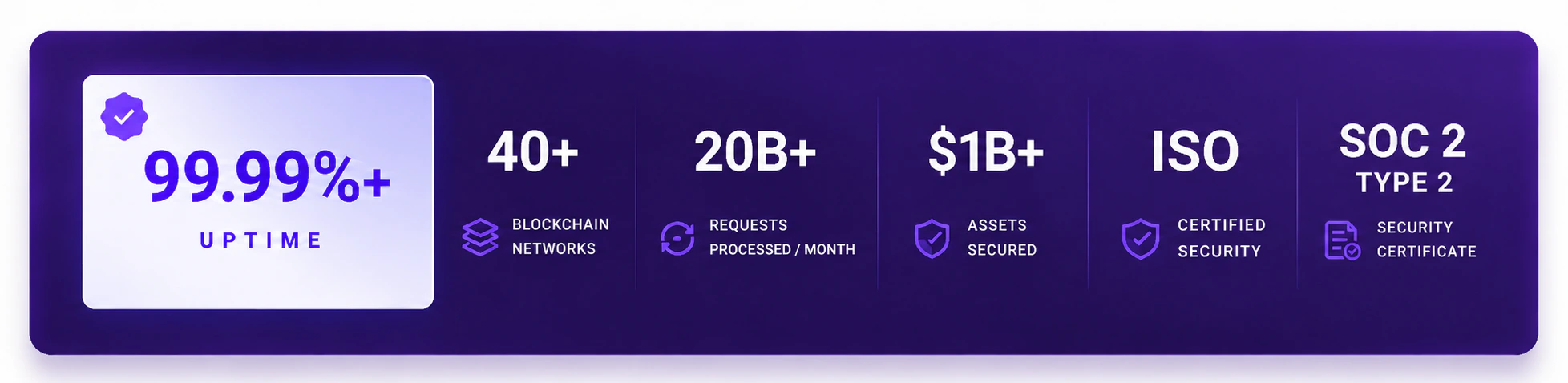
Over more than five years in production, Gateway has built infrastructure supporting more than 20+ billion requests each month, and 40+ global customers.
Gateway-operated validators support more than $1+ billion in assets secured. The company operates across the United States, Europe and APAC, with SOC 2 Type II, ISO 27001 and PwC-audited financial statements forming part of its institutional assurance posture.
Gateway has not assembled this positioning around a future product concept. The technology stack is ready. The operating capability exists. The market has now reached the problems it was built to address.
The transition will take a decade. Gateway is committed to the full journey.
The movement of institutional finance onchain will not be completed through one protocol, one regulatory framework or one infrastructure cycle.
It will advance through controlled deployments, hybrid architectures, new financial products, policy development and gradual interoperability between institutions, networks and jurisdictions. Some organisations will begin with payments. Others will begin with tokenized deposits, funds, bonds, private credit, collateral or privacy-preserving workflows.
Gateway will support that transition as a technology provider, infrastructure operator, integration partner and strategic adviser.
We will publish technical research, commit to provide material for education and awareness, reference architectures and implementation frameworks that make sovereign onchain finance more legible to institutions. We will work with banks, payment companies, market infrastructures, regulated enterprises and public-sector organisations through architecture discovery, product design, partner selection, deployment, migration and production operations.
The objective is to help institutions adopt frontier infrastructure without surrendering authority, rebuilding the entire stack internally or isolating themselves from the markets they need to reach.
Sovereign networks provide the control. Sovereign interoperability provides the connection. Privacy and identity govern participation. Liquidity, secondary markets, custody and insurance connect the technology to the financial economy. Institutional orchestration makes the complete system operable.
Gateway is the institutional infrastructure orchestrator for sovereign onchain finance.
Share post
Too good to keep to yourself... Share it with your network!
Read next