From devnet to mainnet with Miden
Most of our work is with banks and market infrastructures. Whatever they plan to put on a shared ledger, whether deposits, payments, securities or collateral, the first question is always the same: who will be able to see our data?
On most blockchains, the honest answer is everyone. Balances, payment histories and counterparties are all public by default. That openness is useful for some things. For a treasury desk, a fund or a bank with clients, it ends the conversation. No institution will move real financial activity onto a ledger that shows its positions to competitors.
That is why privacy sits at the centre of everything we build at Gateway. And it is why the launch of Miden's partner mainnet matters.
Why Miden is worth paying attention to
Miden takes on the privacy problem at the deepest possible level: the protocol itself.
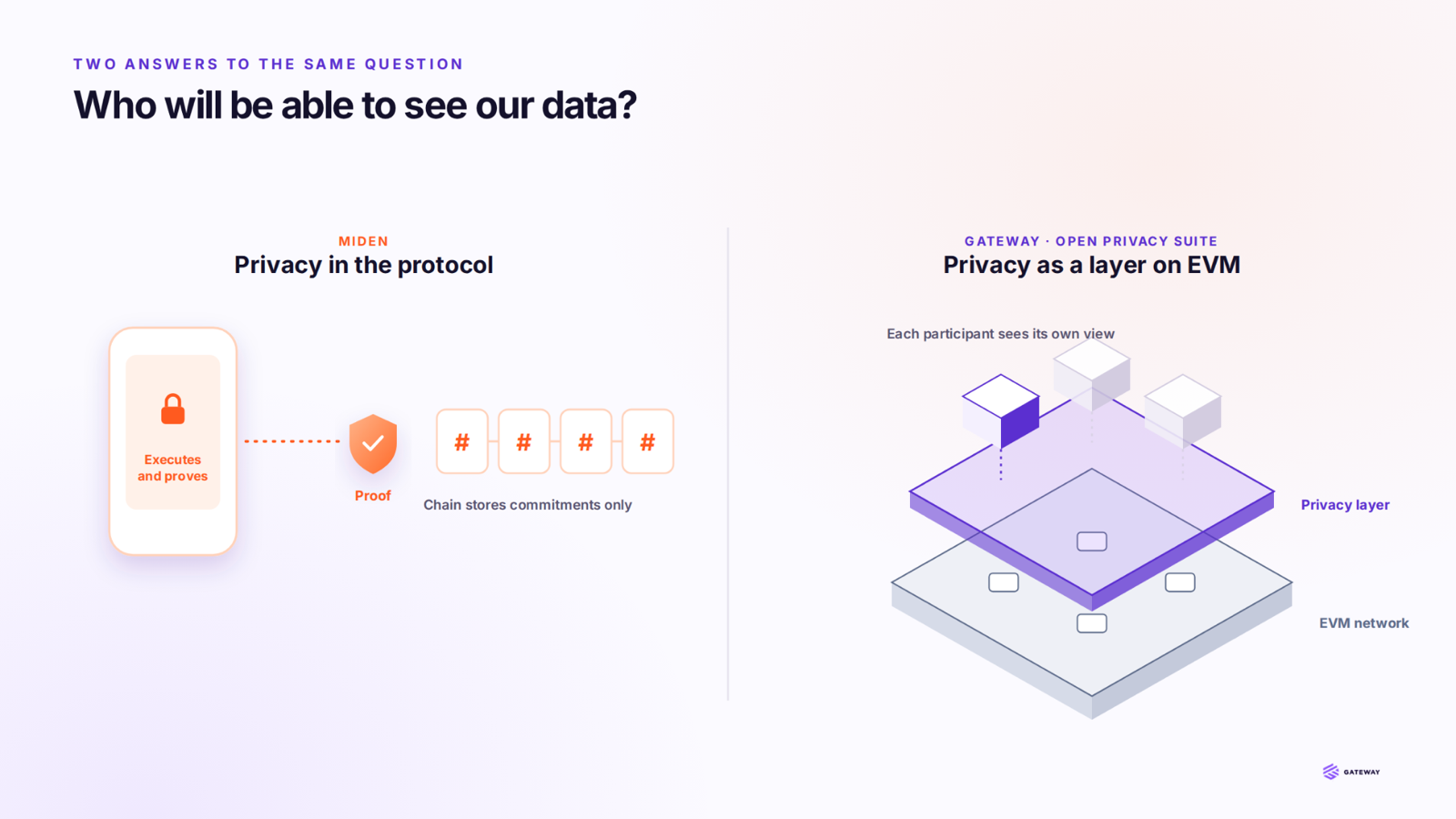
On most chains, the network executes every transaction in public. On Miden, users execute their transactions on their own devices and either prove them there or hand proving to a prover service, and send the network a proof. For a private account, the chain stores only a commitment: a cryptographic fingerprint that proves the state is valid without revealing what it contains. For a private note (the object Miden uses to move assets between accounts), the chain records that the note exists and who sent it, but not what it carries. Users can transact without making their balances and payment amounts publicly visible. Anyone who needs to be public still can be.
That is a genuinely different design. Privacy is not added afterwards; the protocol is built around it. With partner mainnet live, launch partners are now building on the network, and invited users are moving real assets through Bread, Miden's private wallet, ahead of wider access.
Two answers to the same question
Our own work on privacy started from a different place.
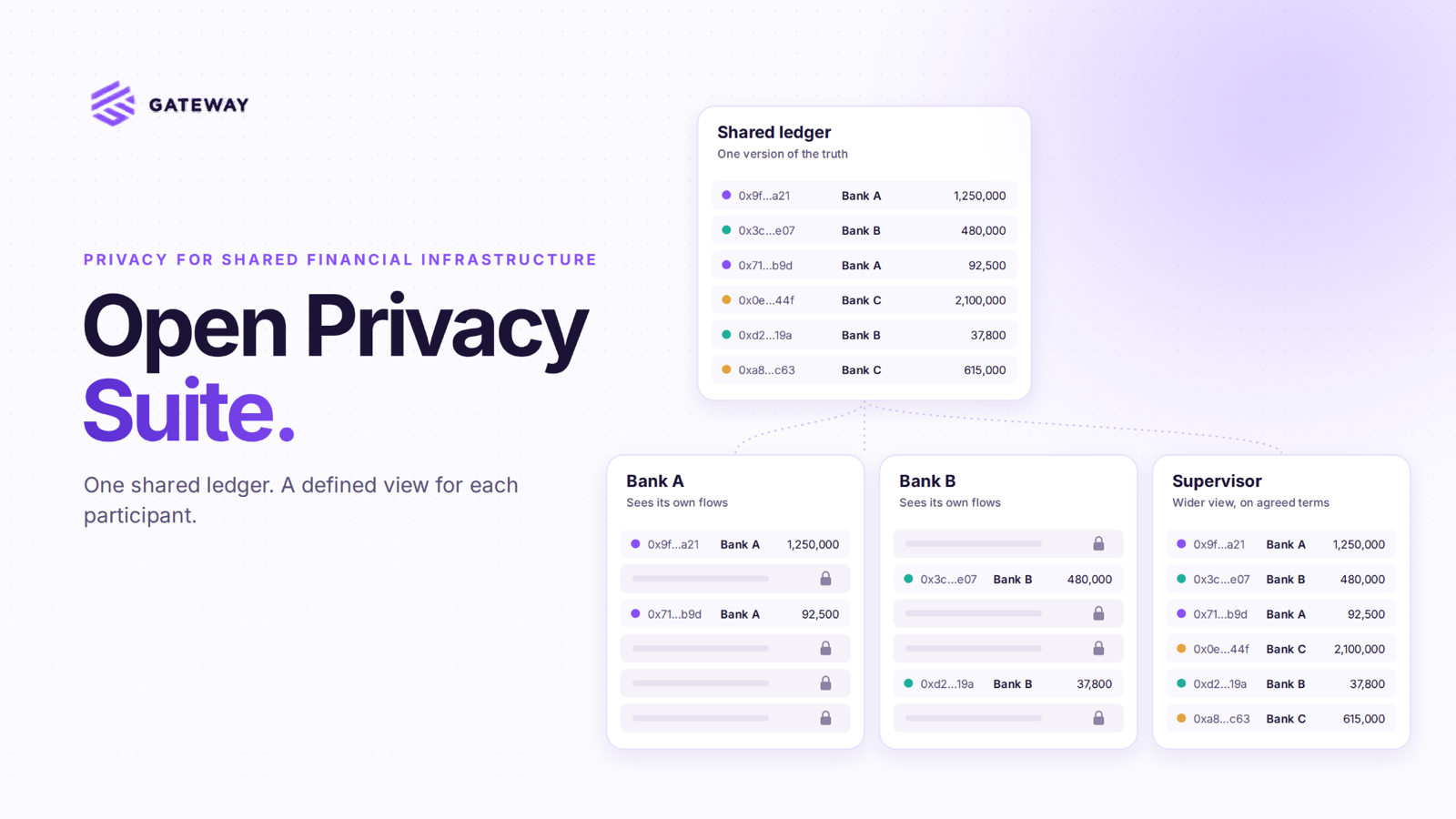
Many institutions are building on EVM networks: their own sovereign networks, or shared networks with other banks. They want to keep that stack, along with its contracts, tooling and talent. For them, we built Open Privacy Suite, a privacy layer that attaches to an EVM network without changing the chain. It controls what each participant can read, governs who can change those rules, and gives supervisors a defined, logged view. Institutions can run it on their own network, or take a sovereign network from Gateway with the privacy layer already in place.
Miden starts from the other end, with privacy as a property of the protocol rather than a layer on top. Neither approach replaces the other. They suit different institutions, different assets and different stages. What they share is the conviction that finance will not move onchain without privacy, and working on both gives us a rare view of what privacy actually takes to run.
That is why we took on Miden's infrastructure, and why we have stayed with it since devnet.
What we run and what we built
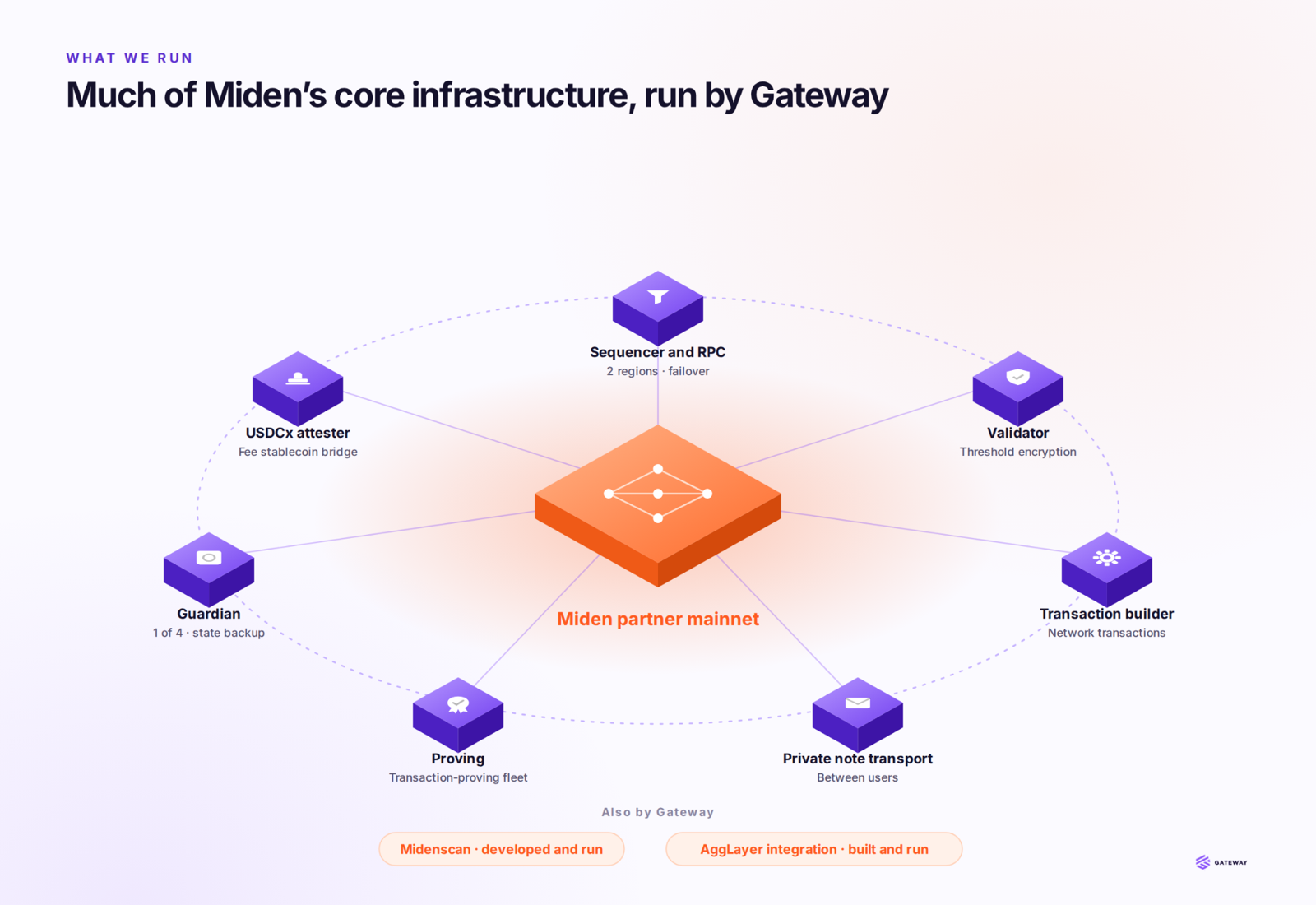
A protocol-level privacy design moves a lot of responsibility onto the infrastructure around it. Private note details never go on chain, so something has to carry them between users. Private account state lives with users, so it has to be backed up and recoverable. And every service that receives, orders and proves activity has to run around the clock. A user who hands off proving shares that transaction with the prover, so the prover has to be run by an operator they can trust.
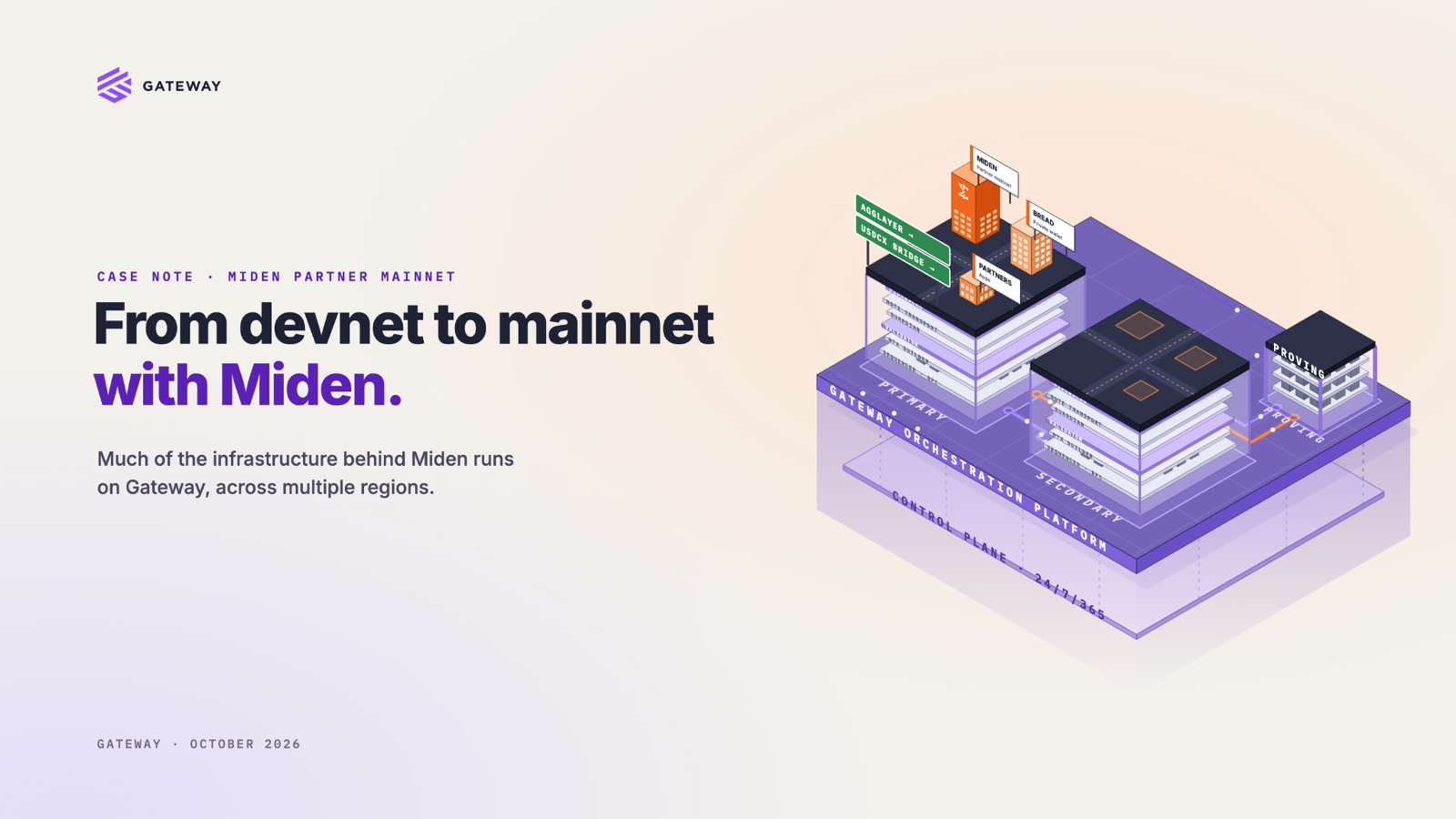
From day one of partner mainnet, Gateway runs much of Miden's core infrastructure:
- The sequencer and RPC, where every transaction enters the network, across two regions with global failover, so the network stays reachable if a region goes down.
- One of the network's validators. During this phase, Miden also shares encrypted transaction data with the validators under threshold encryption, so no single party can decrypt it.
- The network transaction builder, for transactions the network executes itself, and private note transport, which carries private notes between users.
- The proving infrastructure. We run the transaction-proving fleet that wallets and network services use when they don't prove on their own device, built around Miden's prover. Batch and block proofs are produced by the sequencer we operate.
- A Guardian. Miden launched with four Guardian operators, and Gateway is one of them. Guardians back up and sync private account state, so users can recover their accounts.
- The USDCx bridge attester, supporting the USDC-backed stablecoin used to pay network fees.
We also develop and run two pieces that shape how people see and use the network.
Midenscan, the network's block explorer.
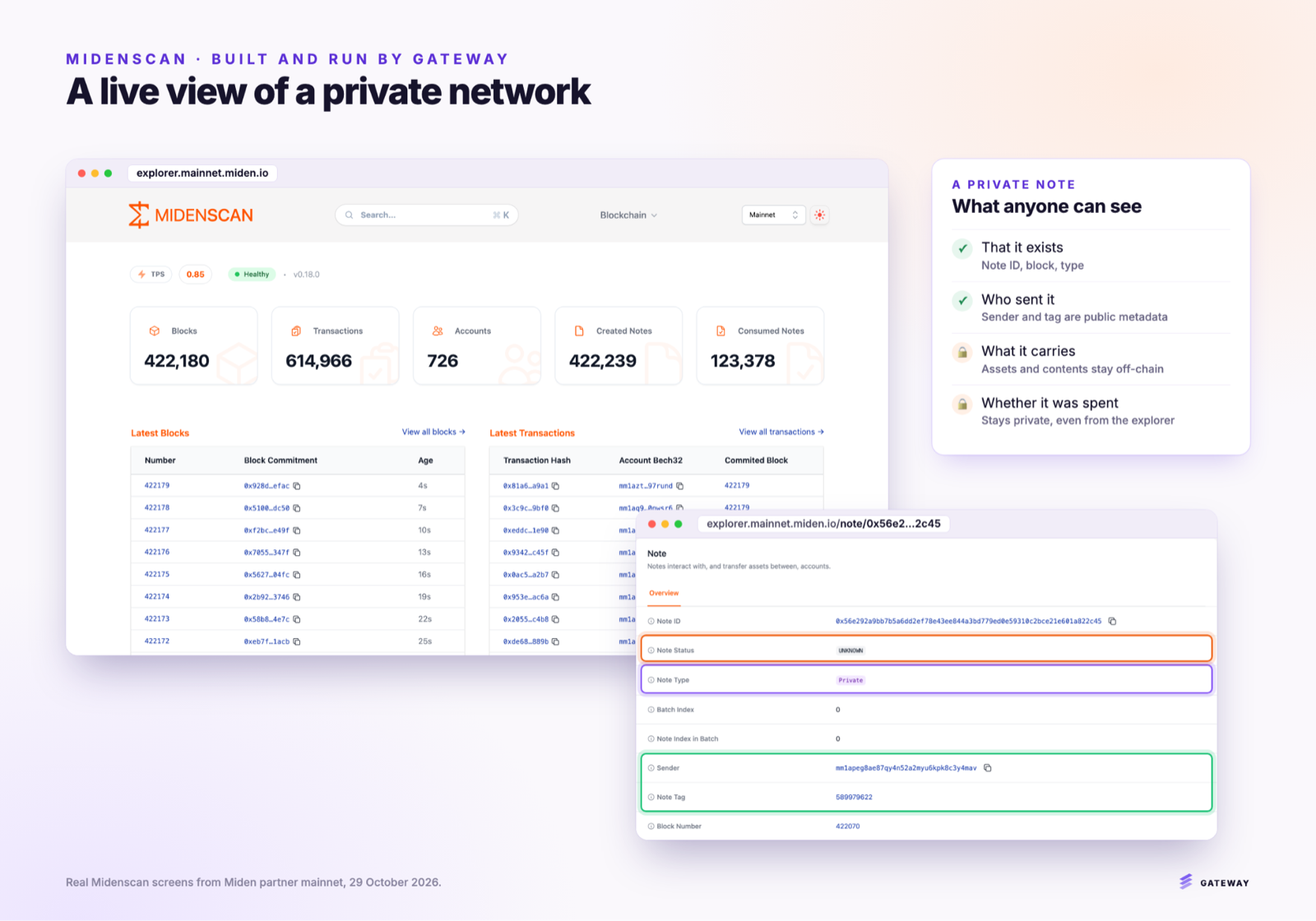
On most chains, an explorer simply shows everything. A privacy network makes the job more delicate: it has to show that the network is live and working, to anyone who looks, without exposing what it is designed to protect. Gateway develops and runs Midenscan, including the indexer that follows every new block and records its accounts, notes, transactions and nullifiers. It shows blocks, transactions, accounts, account updates, and created and consumed notes, so users, partners and auditors can follow the network's activity. For a private account, the chain records only a commitment to its state. For a private note, Midenscan shows that it exists and who sent it, but never what it carries.
Beyond Miden, block explorers are a core part of what Gateway offers. Our own explorer is privacy-aware for institutional networks and built for scale: in a proof of concept, it indexed a separate custom chain at close to 3,000 transactions per second, in real time.
The Agglayer integration.
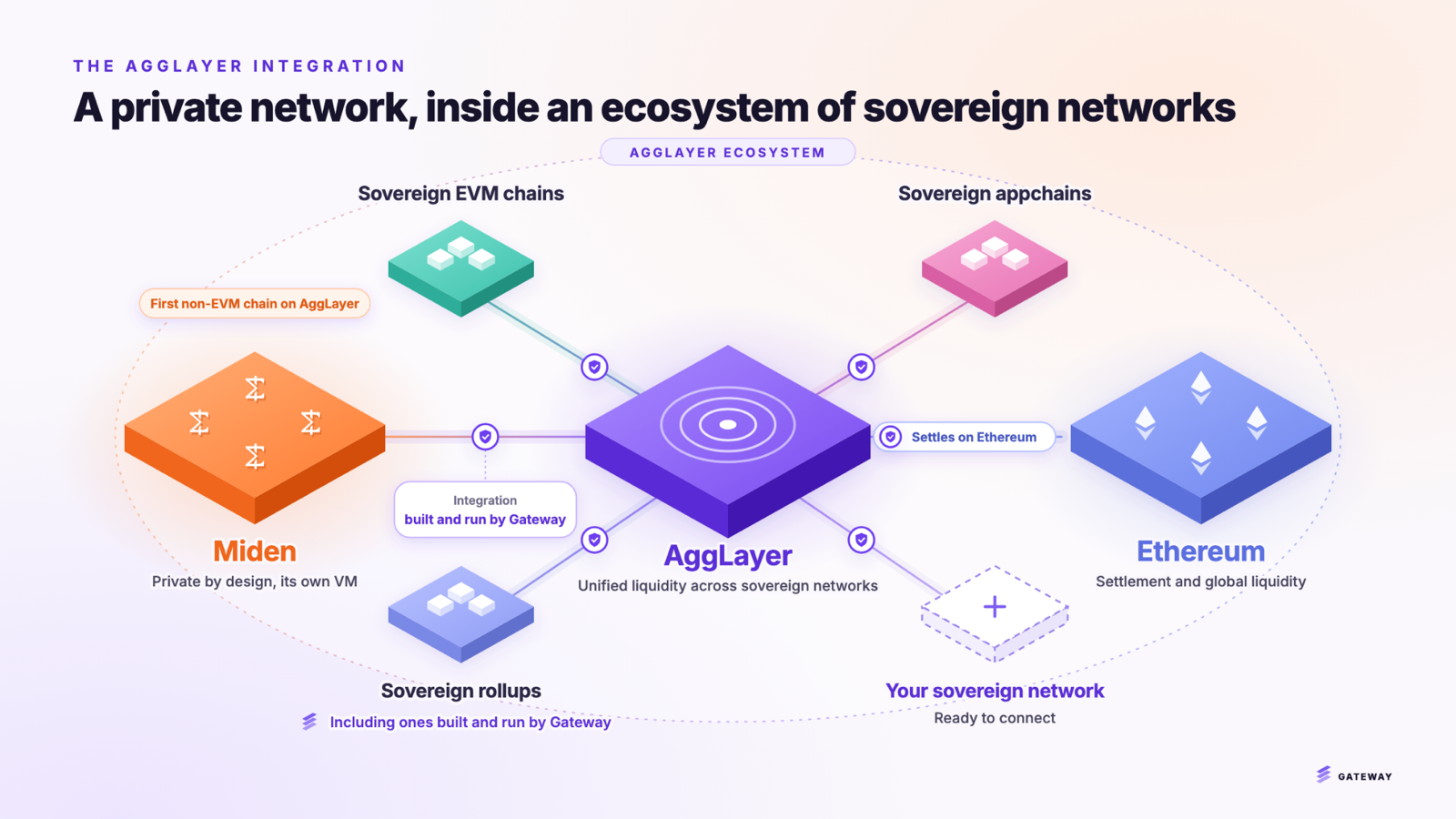
A private network also has to connect to the rest of the market. Agglayer brings sovereign networks into one ecosystem: each keeps its own rules, and all of them share liquidity through one bridge on Ethereum. It was built around EVM chains. Miden is not one: it has its own virtual machine, its own account model and note-based transfers. Our engineers built the integration service that connects the two, and we run it on mainnet. It presents an EVM-style interface to Agglayer's standard bridge tooling, turns incoming bridge transactions into native Miden notes, and records outgoing ones in a form Agglayer can verify. Agglayer works with Miden as it is, and Miden doesn't have to pretend to be an EVM chain. The result: Miden is the first non-EVM chain in the Agglayer ecosystem, alongside sovereign rollups, including ones Gateway builds and runs.
None of this was assembled for launch day. We have worked with Miden for about a year, from devnet through testnet to partner mainnet. Each upgrade went through our infrastructure, and what we learned in operation went back into the next release.
What it means for institutions
Institutions are past asking whether privacy on a ledger is possible. They want to know whether it can run reliably, connect to the rest of the market, and give the right people the right view.
Miden's partner mainnet is a live example of all three, built on protocol-level privacy. Open Privacy Suite and the sovereign networks we build for banks and market infrastructures answer the same question for the EVM world. Being able to offer both, and run both, is how we intend to help institutions take real activity onchain.
Partner mainnet is a first phase, and access will widen from here. We will keep running and building as it does, and once the network opens further, we will share a fuller case study with operating data.
Congratulations to the Miden team, and thank you for trusting us with your infrastructure.
Have a Bread invitation? Enter your code to access partner mainnet. Need one? Join early access at miden.xyz/bread. Explore the network on Midenscan, and follow @0xMiden for updates.
Share post
Too good to keep to yourself... Share it with your network!